Smart shoppers routinely walk past valuable thrift items hiding in plain sight on dusty store shelves. Knowing which labels, metals, and makers hold strong resale value helps you stretch every dollar.
American thrift shoppers save an average of $1,452 per year by buying secondhand, according to Capital One Shopping. Whether you shop to furnish your home cheaply or flip secondhand treasures online, a few reliable habits protect your budget.
This guide breaks down real completed sales, marketplace fees, safety checks, and tax rules so your next thrift trip pays off.
Why Secondhand Treasures Are Paying Off Right Now
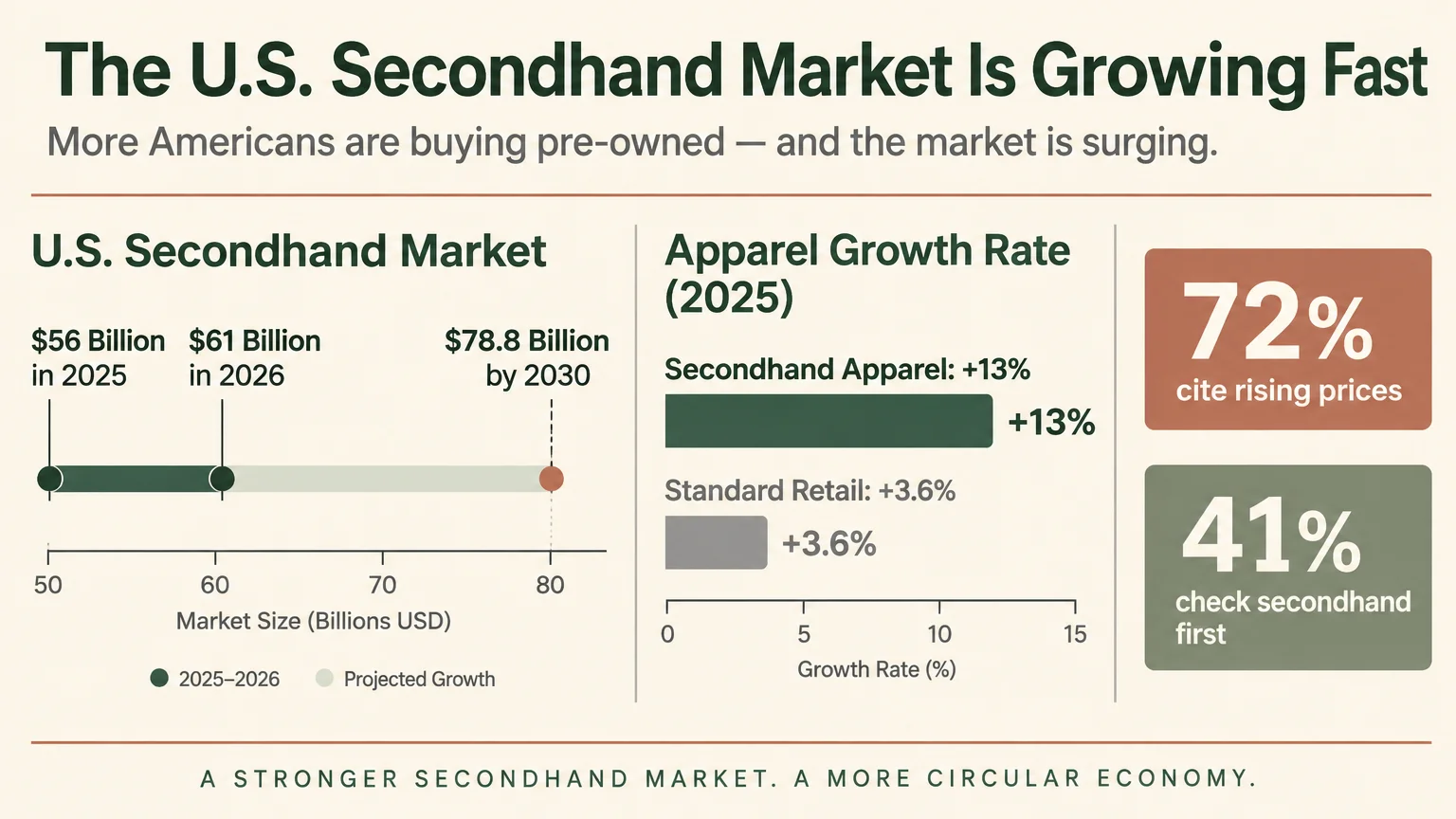
Secondhand shopping has shifted from a quiet weekend pastime into a mainstream household strategy. ThredUp and GlobalData estimate the overall U.S. secondhand market at $61 billion in 2026, up from $56 billion in 2025.
Capital One Shopping projects that total secondhand spending could reach $78.8 billion to $79 billion by 2030. Strong buyer demand means well-chosen thrift store finds sell faster than ever before.
Clothing alone tells a clear story about why buyers flock to used goods. Heading into 2026, ThredUp reports a $43 billion U.S. secondhand apparel market that grew nearly four times faster than broader retail clothing in 2025.
Secondhand apparel expanded by 13% and curated online resale grew 19%, compared with just 3.6% for standard retail clothing. Tight household budgets explain that gap.
According to ThredUp, 72% of U.S. shoppers say rising prices directly shape their clothing spending. About 59% bought secondhand apparel in 2025, and 41% now check secondhand options first when hunting for value.
Transaction data from Bank of America cited by IBISWorld similarly recorded a 22.0% surge in thrift store purchases as retail clothing prices climbed. When new goods cost more, durable older items gain steady resale value.
For retirees and fixed-income households, thrifting strengthens the gap between a fixed expense and a variable expense. A fixed expense stays predictable each month, like rent or an insurance premium, while a variable expense moves up and down, like groceries or household goods.
Trimming your variable costs at the thrift rack frees up cash for a dedicated sinking fund. A sinking fund is a small, separate cash reserve you build gradually to handle irregular bills like car tires, home repairs, or winter heating spikes.
Vintage Cookware and Kitchen Finds That Hold Real Value
Kitchen aisles deliver some of the steadiest bargains for both home cooks and part-time resellers. Gitnux industry figures show that home goods make up roughly 30% of thrift store revenue, while kitchenware accounts for another 15%.
Shoppers pay an average of $22 per home goods item and $18 per kitchenware set. When you spot a sought-after maker among those $18 sets, your margin climbs quickly.
Pre-1998 Pyrex Mixing Bowls
Collectors prize vintage American Pyrex bowls produced before 1998 because the company made them from borosilicate glass. Borosilicate glass is a durable, heat-resistant glass formula that handles sudden temperature shifts better than modern soda-lime glass.
Resale value depends heavily on pattern rarity and surface condition. FlipTip AI analyzed 104 completed eBay sales between July and October 2026 and found sharp differences across designs.
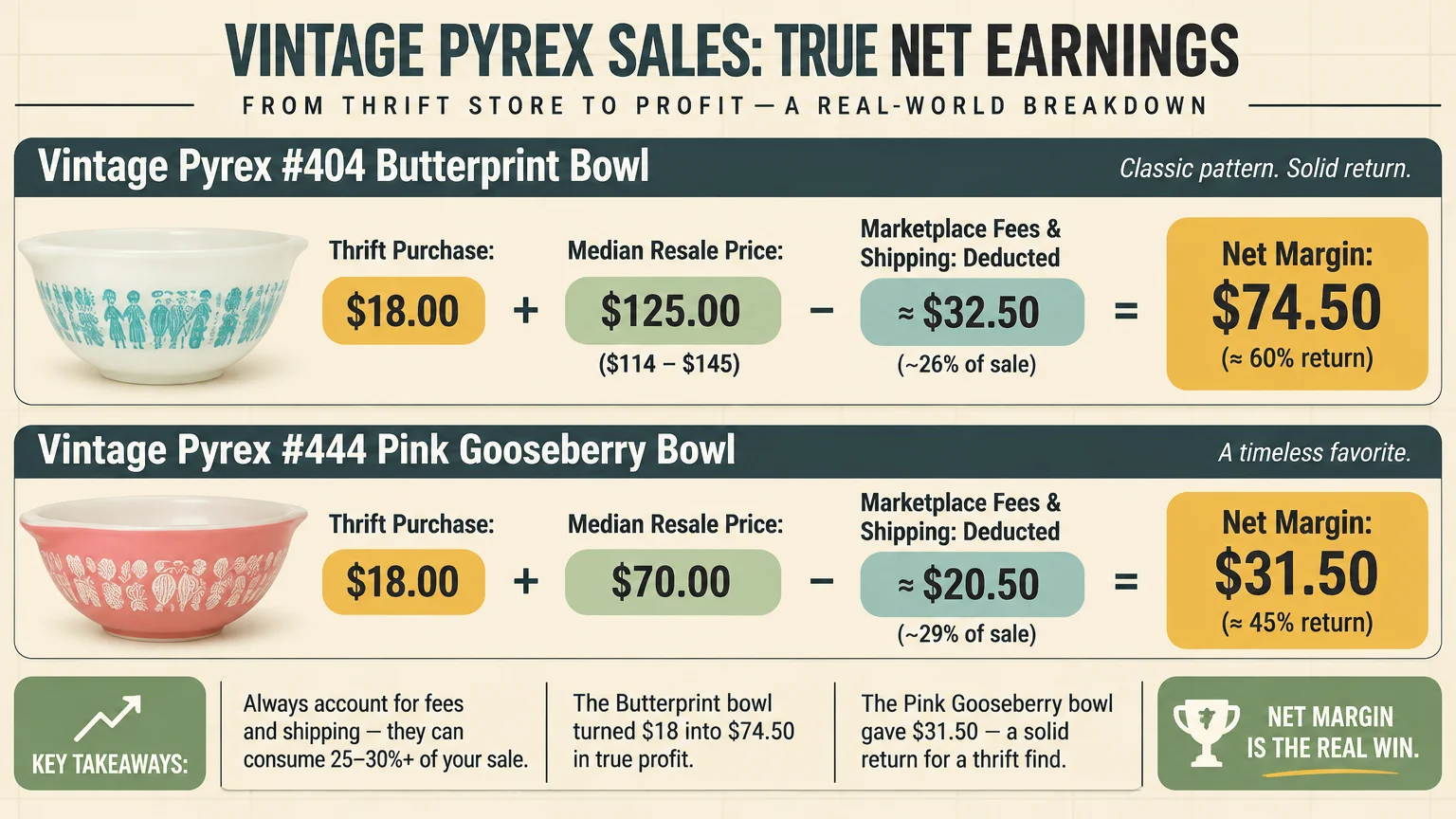
A Butterprint #404 four-quart mixing bowl achieved a median price of $125, with the middle half of sales landing between $114 and $145. A median price marks the exact midpoint of completed sales, keeping rare outliers from skewing your expectations.
In that same completed-sales review, a Pink Gooseberry #444 bowl reached a median price of $70. Unpatterned clear bowls or pieces scarred by harsh dishwasher cycles bring far less.
Hold every vintage bowl under overhead store lights before dropping it into your cart. Chalky, faded paint and deep scratches signal heavy dishwasher wear that slashes collector demand.
Griswold and Wagner Ware Cast Iron
Heavy cast iron skillets often sit unpriced or buried on bottom shelves because they look rusty or crusted with old seasoning. Beneath decades of kitchen grime, vintage American iron frequently carries impressive resale value.
FlipTip AI sales data shows that Griswold cast iron skillets regularly bring two to four times the resale value of Wagner Ware. Checking the underside for the distinctive Griswold cross logo takes seconds.
Completed eBay sales analyzed by FlipTip AI show a Griswold #10 skillet in pattern #716 sold for a median of $180, with the middle half ranging from $140 to $239. A Griswold #8 skillet brought a median of $105, ranging from $79 to $160 for the middle half.
Even a small Griswold #3 skillet earned a median price of $34. Before buying any cast iron, set the skillet on a flat metal shelf to test for warping or spinning.
A flat bottom sits steadily on glass-top stoves and commands top dollar from buyers. Skip any pan with a hairline crack along the rim or sidewall, since cracks ruin both safety and collector value.
Enameled Cast Iron Dutch Ovens
High-end French enameled cookware blends serious kitchen performance with lasting demand. Intact Le Creuset Dutch ovens consistently sell for $70 to $280 on eBay.
Always inspect the interior enamel surface under bright light before looking at the price tag. Exterior scuffs and lid marks clean up easily, while interior enamel chips or heavy crazing hurt resale value.
Crazing looks like a fine web of tiny hairline cracks across the glossy glaze. If the interior enamel is smooth and chip-free, an enameled Dutch oven is one of the strongest valuable thrift items you can carry out the door.
Myth-Busting: Thrift Store Finds That Rarely Pay Off
Viral social media posts often convince casual shoppers that every retro dish on a thrift shelf is a retirement windfall. Learning which famous names actually disappoint protects your wallet from costly mistakes.
The Viral CorningWare Valuation Trap
Every few months, online posts claim classic white CorningWare casserole dishes sell for thousands of dollars. Completed marketplace data tells a much more grounded story.
According to FlipTip AI completed eBay sales, classic Cornflower Blue and Spice of Life CorningWare dishes actually bring a median price of $15 to $20. Because thrift store kitchenware sets already average $18, flipping common CorningWare online usually loses money once you pay shipping and fees.
Buy classic CorningWare if you want sturdy, easy-to-clean bakeware for your own kitchen table. Leave it on the shelf if your goal is turning a quick profit online.
Overpriced Home Goods and Trendy Accessories
Many thrift chains now price recognizable department-store brands near retail clearance levels. Gitnux data shows handbags and accessories average $35 per item at U.S. thrift stores, while general home goods average $22.
At $35, a worn designer-inspired tote leaves almost no room for profit after cleanup, photography, and shipping. One of the smartest thrifting tips is checking completed sold listings on your phone rather than active asking prices.
Anyone can ask a wild price online, yet only completed sales prove what buyers actually pay. If sold prices sit close to the store sticker, walk away and save your cash for genuine secondhand treasures.
Precious Metals and Hidden Drawer Treasures
Jewelry cases, tarnished tray bins, and miscellaneous silverware baskets deserve a careful look on every visit. Store sorters move quickly and occasionally overlook solid sterling silver or gold mixed into plated costume pieces.
Even after short-term market swings, precious metal spot prices give solid finds remarkable underlying worth. A spot price is the live market value for immediate delivery of a raw metal.
According to Fortune and USAGold, silver traded at $47.36 to $47.48 per troy ounce on November 17, 2026. A troy ounce is a precious-metal weight unit equal to roughly 31.1 grams, slightly heavier than a standard kitchen ounce.
Although silver pulled back from roughly $51.04 on November 12 and $60.93 a month earlier, it remained up over 150% year-over-year in early November. Gold traded between $3,841.58 and $3,857.36 per troy ounce on November 17, 2026.
Carry a small pocket magnet whenever you browse flatware bins and jewelry trays. Real sterling silver and solid gold are not magnetic, so anything that snaps onto your magnet is plated steel or base metal.
Inspect clasps, ring interiors, and fork backs with a small magnifying loupe for hallmark stamps. Look for 925 or Sterling on silver, and 10K, 14K, or 18K on gold.
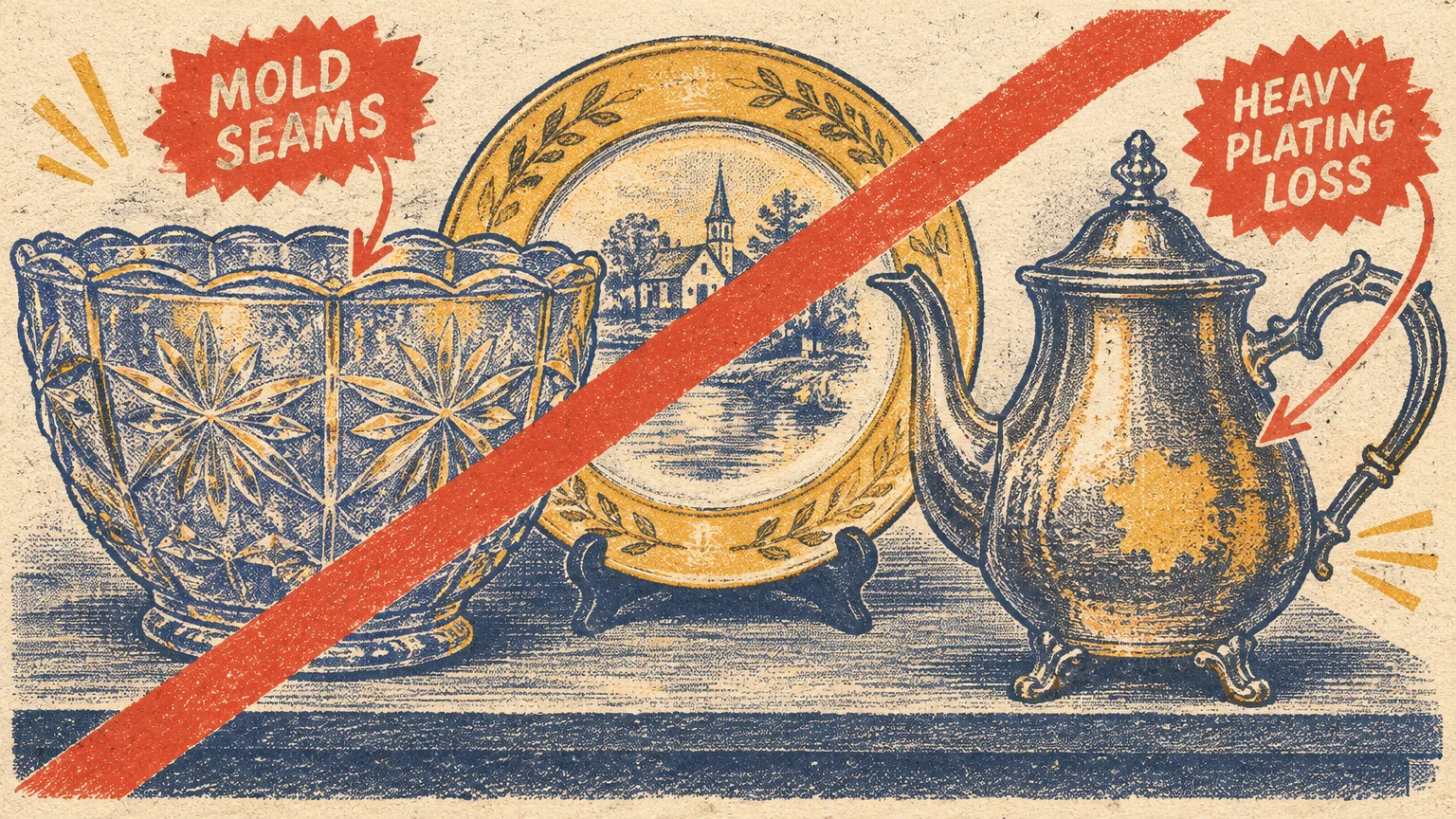
Watch out for letters like EPNS, which stands for electroplated nickel silver and holds virtually no precious metal weight. Weighted sterling candlesticks also contain cement or resin cores, meaning only the thin outer silver shell counts toward melt value.
Safety Checks, Recalls, and Lead Hazards You Cannot Ignore
A low sticker price never justifies bringing an unsafe product into your home or passing a hazard onto another buyer. Federal rules treat resellers seriously, whether you run an online shop or host a neighborhood yard sale.
Why Recalled Products Are Off-Limits
Under guidelines from the U.S. Consumer Product Safety Commission, or CPSC, it is illegal for thrift stores, yard-sale sellers, and online resellers to knowingly sell any CPSC-recalled product unless it has been properly repaired under the recall. The CPSC issues roughly 300 to 500 product recalls every year.
Store tags do not guarantee an item passed a safety screen. In a CPSC study of 301 thrift stores, 69% carried at least one hazardous item on their sales floors.
The most frequent violations included children’s outerwear with neck drawstrings, older hair dryers lacking built-in electrocution protection, and non-compliant cribs. Always check model numbers and brand names against official recall databases before buying electronics, baby gear, or small appliances.
Cribs, Children’s Jewelry, and Lead Rules
If you buy nursery items for visiting grandchildren, inspect manufacturing dates with extra care. Most cribs built before June 2011 may not be resold under federal CPSC standards due to drop-side hardware and structural hazards.
Federal lead caps also protect children’s items made primarily for ages 12 and under. Paint and surface coatings, including coatings on moveable painted furniture, are capped at 90 parts per million, or ppm, while accessible component parts are capped at 100 ppm.
One ppm measures how many tiny units of lead exist inside one million units of material. While thrift stores are generally excluded from lead-content compliance testing on donated used goods, children’s metal jewelry receives no exemption and must meet the 100 ppm lead limit.
Skip chipped vintage painted toys, unmarked children’s metal trinkets, and older painted cribs altogether. Buying safer modern gear or keeping vintage pieces strictly out of children’s reach protects your family.
Vintage Fiestaware and Old Appliances
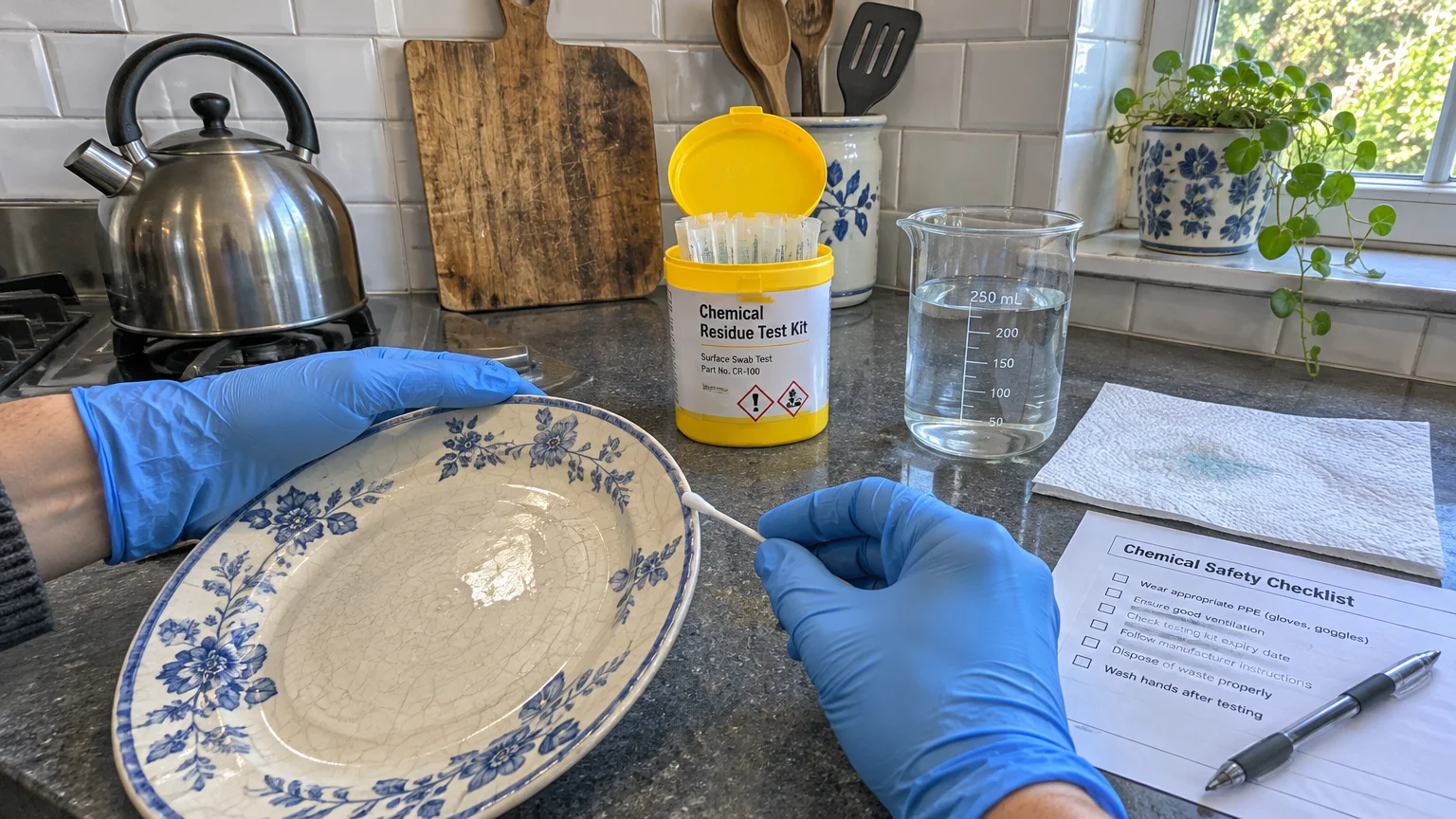
Brightly colored vintage ceramics draw instant attention on thrift shelves, yet older glazes carry hidden chemical risks. Original vintage Fiestaware made between 1936 and 1972 used uranium oxide in certain glazes, making pre-1972 dishes mildly radioactive.
Fiesta products were not certified lead-free until 1992, though the manufacturer Fiesta states its production has been lead-free since 1986. Safety advocates such as Lead Safe Mama advise never using vintage or antique ceramic dishware for food or drink.
If you buy modern post-1986 Fiestaware for daily meals, follow manufacturer care guidelines closely. Avoid pieces with cracked or chipped glazes, never heat plates above 500 degrees Fahrenheit, and keep them away from open flames or broilers.
Use similar caution around old thrift-store appliances, space heaters, and plumbing hardware. Vintage electric heaters and outdated faucets can spike utility bills or introduce worn wiring and older materials, so compare efficiency ratings before choosing secondhand hardware over certified modern replacements.
Online Marketplace Fees and Real Net Profit Math
Finding an underpriced treasure is only half the equation when you plan to resell online. Before celebrating a high listing price, calculate your net profit—the cash you actually keep after subtracting purchase cost, shipping, supplies, and marketplace fees.
Every major platform structures its final value fee differently. A final value fee is the commission a marketplace deducts once your buyer completes payment.
On eBay, sellers receive 250 free listings per month, per the eBay Seller Center. Final value fees range from 2.5% to 15.3% depending on the item category, plus a per-order fee of $0.30 for orders of $10.00 or less or $0.40 for orders over $10.00.
Mercari uses a different structure documented by Nifty for listings created or updated after January 6, 2026. Mercari eliminated its 2.9% plus $0.50 seller payment processing fee and now charges sellers a flat 10% fee on the total sale price, including buyer-paid shipping.
Mercari buyers pay a 3.6% protection fee at checkout, while sellers pay $3 for Instant Pay cashouts. Be sure to weigh heavy cookware on a kitchen scale before listing on Mercari, because underpaid package weights or dimensions trigger an 8% shipping correction fee.
Poshmark keeps its fee schedule simple, per Nifty. Sellers pay a 20% commission on sales of $15 or more, or a flat $2.95 fee on sales under $15.
Because heavy cast iron and glass bowls require double-boxing and sturdy bubble wrap, factor box weight into every shipping estimate. Choosing buyer-paid calculated shipping prevents heavy packages from erasing your margin.
Worked Examples: From Thrift Shelf to Real Net Profit
Running real numbers before you reach the register separates lucky guesses from repeatable savings. The three examples below apply verified average thrift prices and completed sales figures so you can see how the math works.
Example A: Flipping a Griswold #8 Cast Iron Skillet
Suppose you spot a flat, crack-free Griswold #8 skillet priced at $22, matching the Gitnux average for thrift store home goods. You list it on eBay with buyer-paid shipping and sell it for $105, matching the FlipTip AI verified median.
On a $105 sale over $10.00, eBay deducts its $0.40 per-order fee plus a category final value fee between 2.5% and 15.3%. At the 15.3% high end, fees total $16.47, leaving $66.53 in net profit after subtracting your $22 purchase cost.
At the 2.5% low end, fees total just $3.03, leaving $79.97 in net profit before packing tape and box costs. Inspecting the skillet bottom carefully turned a $22 shelf pickup into roughly $67 to $80 of extra budget room.
Example B: Pyrex Bowl vs. CorningWare on Poshmark
Imagine paying the $18 Gitnux average for a thrift kitchenware piece and selling it on Poshmark. If you find an intact Pink Gooseberry #444 Pyrex bowl, it carries a verified FlipTip AI median resale price of $70.
Poshmark charges a 20% commission on sales of $15 or more, which equals $14 on a $70 sale. Subtracting the $14 fee and your $18 purchase cost leaves $38 in net profit.
Now compare that same $18 purchase price on a classic Cornflower Blue CorningWare dish selling at its $20 upper median. Poshmark deducts a $4 fee, leaving $16 in payout and putting you $2 behind before you even buy packing tape.
Example C: Turning Thrift Savings Into a Senior Sinking Fund
You do not have to resell a single item online for thrifting to transform your monthly cash flow. Using Capital One Shopping’s average of $1,452 in annual thrift savings, a household frees up $121 every month.
On a fixed retirement income, moving $121 per month into a dedicated sinking fund creates real breathing room over a single year. You can apply that reserve toward seasonal utility spikes, prescription copays, or unexpected home maintenance without tapping retirement principal.
Many local thrift stores also run weekly senior discount days or loyalty punch cards for older adults. Ask at the checkout counter about age thresholds, valid ID requirements, and store-specific exclusion tags before you start filling your basket.
IRS Form 1099-K Rules and Tax Basics for Resellers
Tax confusion scares many casual sellers away from cleaning out closets or flipping weekend finds. Knowing current federal reporting thresholds keeps your record-keeping simple and stress-free.
Under the One Big Beautiful Bill Act, signed into law on July 4, 2025, Congress repealed the previously planned $600 and $2,500 phase-in reporting thresholds. As confirmed by TaxAct, H&R Block, and the eBay Seller Center, online marketplaces and payment apps issue a federal Form 1099-K for 2025 and 2026 only when gross payments exceed $20,000 and 200 transactions.
Keep two important exceptions in mind when tracking sales across platforms like eBay, Poshmark, Venmo, or PayPal. Some states enforce lower 1099-K thresholds, and direct credit or debit card processing can trigger a 1099-K with no minimum threshold.
Not receiving a Form 1099-K does not make profitable flipping tax-free. According to IRS guidance cited by Tax1099 and TaxSlayer, all net profits from regularly reselling items for profit remain taxable income—usually reported on Schedule C—even below the reporting threshold.
Conversely, selling your own personal household items for less than you originally paid is a personal loss and is not taxable. Keep dated thrift store receipts and a simple mileage or supply log so you only pay tax on true net profit.
Holding time also shapes your tax rate, per TaxSlayer. Items bought to flip and sold in less than one year are generally taxed as ordinary income, whereas items held over one year—or certain collectibles like antiques and art—may qualify for capital gains rules.
Frequently Asked Questions
Do thrift stores offer senior discounts?
Many thrift shops offer senior discount windows on designated weekdays, though age rules and excluded colored tags vary by location. Always verify current store policies at the register and bring a valid photo ID.
How can I tell if an old Pyrex bowl is worth buying?
Check the bottom stamp for pre-1998 American markings and inspect the painted pattern under bright light. Rare designs like Butterprint or Pink Gooseberry hold strong resale value only when the finish remains glossy and free of dishwasher fading.
Should I buy used appliances or plumbing fixtures at a thrift store?
Inspect electrical cords carefully, check recall lists, and weigh utility costs before buying dated hardware. Older hair dryers may lack electrocution protection, and outdated appliances or faucets often waste far more electricity or water than efficient modern units.
Do I owe taxes if I do not receive a Form 1099-K?
Yes, if you regularly buy thrift store finds to resell for a profit, your net profits remain taxable income even below the $20,000 and 200-transaction federal threshold. Selling personal belongings for less than you originally paid is not taxable.
How do I check if a secondhand item has been recalled?
Look for the manufacturer name, model number, and production date on the product label before paying. Search those details on the official CPSC website, especially when shopping for cribs, children’s clothing, or small kitchen appliances.
Helpful Official Resources and Disclosures
Energy efficiency guidance via ENERGY STAR and the U.S. Department of Energy (DOE).
Water savings and fixture labeling via the EPA WaterSense. Home product safety via the U.S. Consumer Product Safety Commission (CPSC).
Retirement and benefits information via the Social Security Administration (SSA) and senior living resources via the AARP.
This article is for informational purposes only and does not constitute financial, tax, legal, medical, or building-code advice. Marketplace fees, tax rules, precious metal prices, and store discount policies vary by region and change over time, so verify details with official sources.
Always check for product recalls, wear protective gear when cleaning or testing old hardware, and consult licensed professionals whenever home projects require permits or technical safety expertise.