
Choosing the right days to run errands stretches your fixed income without forcing you to skip nutritious food or household essentials. Strategic timing pairs quiet store aisles with weekly senior discount days and fresh morning markdowns.
This guide maps out the exact weekly shopping calendar, practical utility cuts, and safe home maintenance steps that protect your monthly budget. You will get clear routines, worked dollar examples, and simple checklists you can start using this week.
Whether you shop for one or two, a few smart calendar shifts can keep hundreds of extra dollars in your checking account every year.
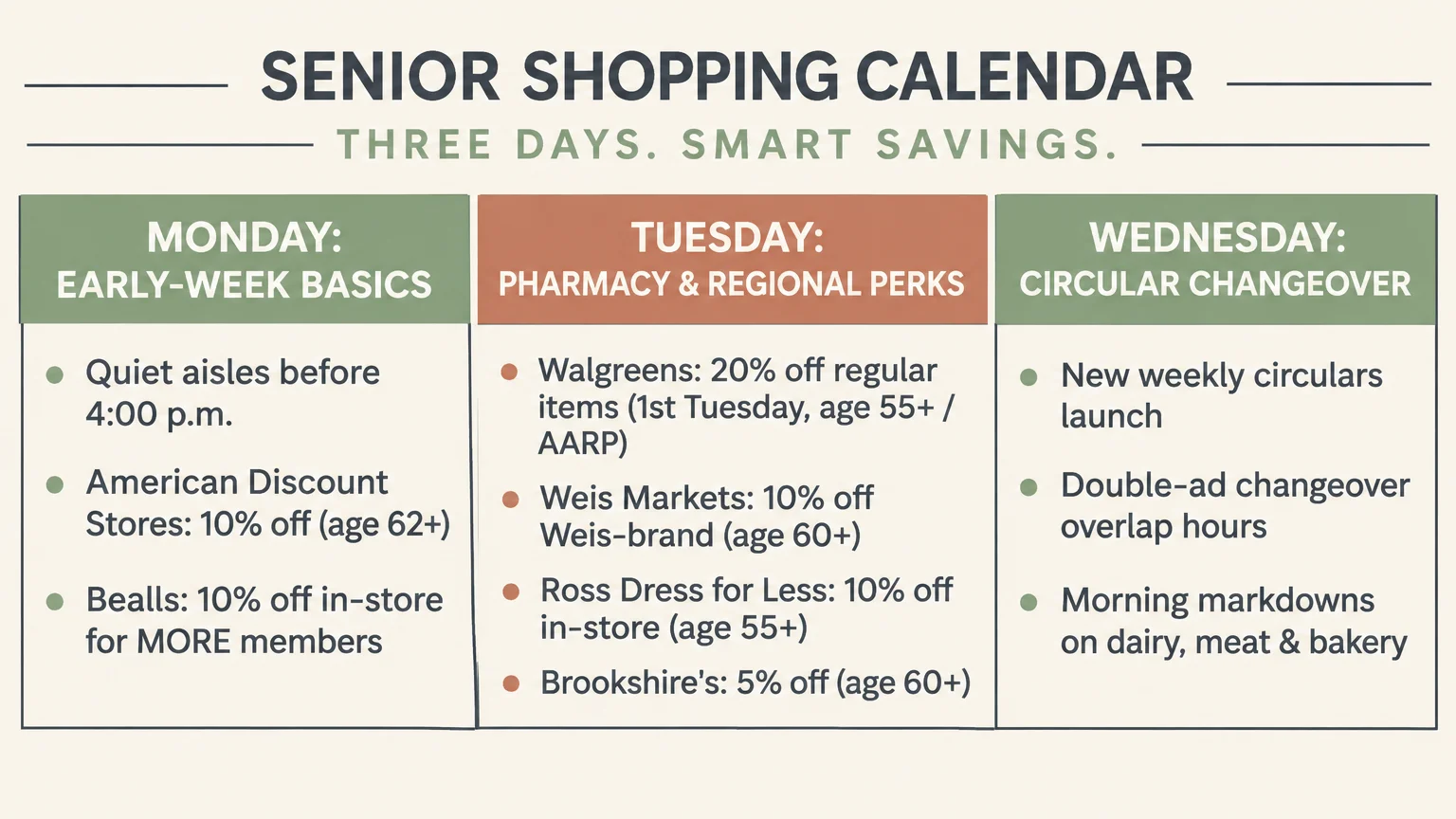
Best Days to Shop: Your Weekly Savings Calendar
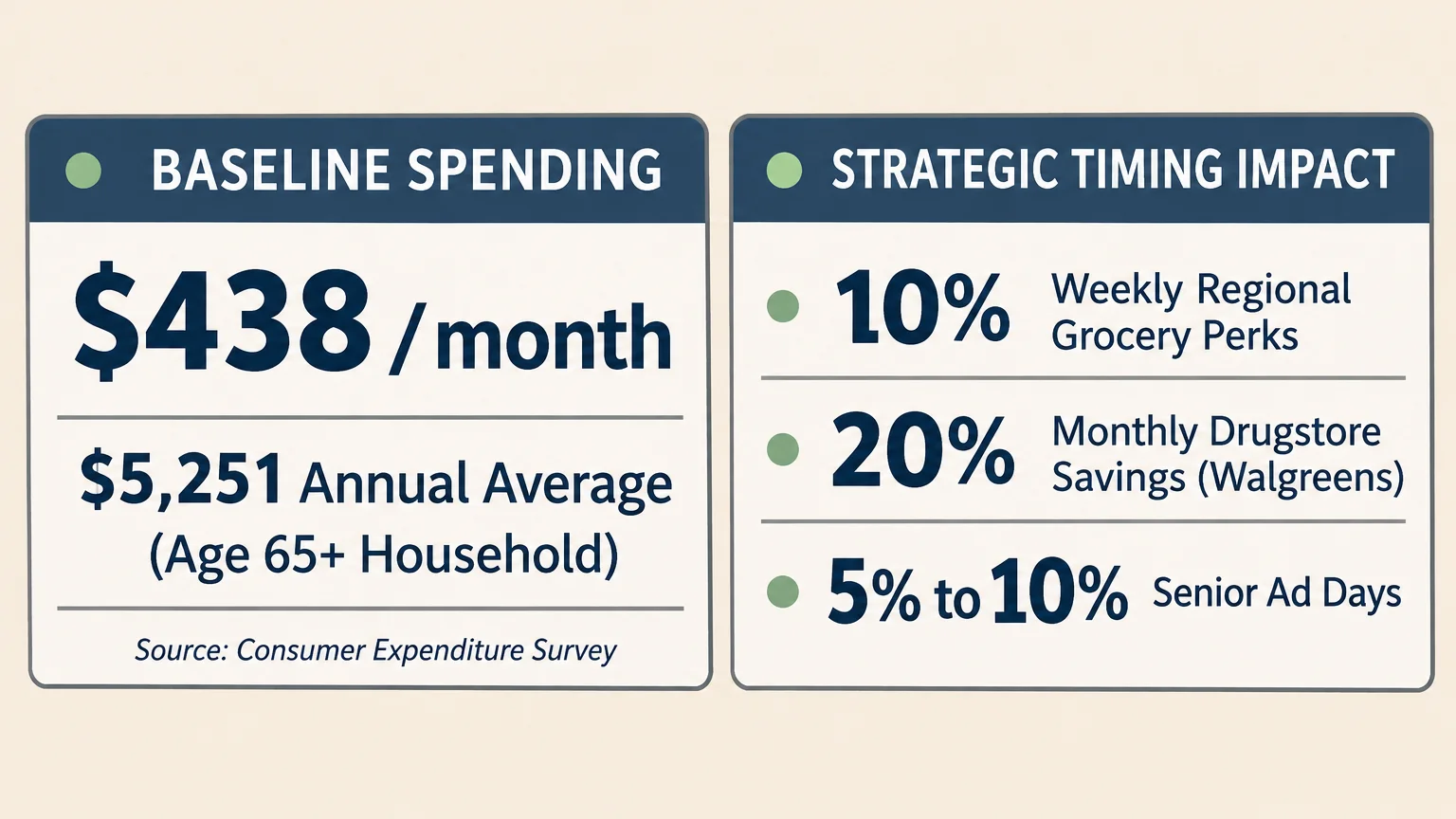
Grocery costs stay top of mind for retirees because food bills eat up a steady share of monthly income. According to the Bureau of Labor Statistics 2024 Consumer Expenditure Survey, households headed by someone age 65 or older spend an average of $5,251 per year—about $438 per month—on groceries.
Inflation has eased from its sharpest peaks, yet prices keep inching upward. The USDA Economic Research Service reported that food-at-home prices rose 2.3% in 2025—driven by jumps of 21.9% for eggs and 11.6% for beef and veal—and stood 1.8% higher in September 2026 than a year earlier.
Timing your trips around store discounts and weekly ad cycles helps you beat those price bumps. You do not need extreme couponing to save money on groceries as a senior; you simply need to match the right errand to the right day.
Monday: Quiet Aisles and Early-Week Basics
Monday mornings offer calm parking lots and freshly restocked produce after the weekend rush. Shopping before 4:00 p.m. on Monday helps you avoid peak afternoon lines and move through checkout quickly.
A few chains also kick off the week with direct markdowns. American Discount Stores gives shoppers 62 and older 10% off every Monday, while Bealls offers 10% off in-store on Mondays for MORE rewards members of all ages.
Tuesday: Peak Day for Pharmacy and Regional Grocery Perks
Tuesday is one of the strongest senior discount days on the calendar, especially for household staples and personal care items. Planning your drugstore and apparel runs for Tuesday mornings maximizes stackable savings.
On the first Tuesday of each month, Walgreens offers myWalgreens members age 55 and older—or AARP members—20% off eligible regular-priced items in-store. Keep in mind that exclusions apply to prescriptions, dairy, alcohol, tobacco, and gift cards.
Regional grocers also reward Tuesday shoppers with valid photo ID and loyalty cards. Weis Markets gives shoppers 60 and older 10% off participating Weis-brand products every Tuesday, and Gristedes Supermarket offers 10% off in-store purchases for ages 65 and older.
In the South, Brookshire’s Food & Pharmacy and Super 1 Foods take 5% off most purchases every Tuesday and Thursday for shoppers 60 and older. On the first Tuesday of the month, Tops Markets grants 6% off for ages 60 and older—including out-of-pocket prescription costs—while Fred Meyer offers 10% off select apparel, home goods, and private-label items for ages 55 and older.
For clothing and home basics, Ross Dress for Less cuts 10% off your entire in-store purchase every Tuesday if you are 55 or older. Show your photo ID at the register before the cashier totals your order.
Wednesday: The Sweet Spot for Weekly Ads and Markdowns
If you only pick one primary grocery day, Wednesday is often your best bet. Most U.S. supermarkets launch their new weekly sales circulars on Wednesday, giving early-morning shoppers first pick of advertised specials.
Some grocery chains honor both the outgoing circular and the incoming circular during Wednesday changeover hours. Shopping early on Wednesday also lines up with fresh morning markdown stickers on meat, dairy, and bakery items nearing their sell-by dates.
Several regional supermarkets pair Wednesday ads with dedicated senior savings. New Seasons Market in the Pacific Northwest gives shoppers 65 and older 10% off most groceries every Wednesday, while Compare Foods Supermarket takes 10% off on Wednesdays for ages 60 or 65 and older depending on the store.
Participating DeCicco Family Markets locations offer 5% off every Wednesday for shoppers 62 and older with an activated Senior Status Preferred Shopper Card. On the first Wednesday of each month, Fry’s Food Stores in Arizona and participating Albertsons stores give shoppers 55 and older 10% off eligible purchases.
Wednesday also shines for department store errands. Kohl’s gives shoppers 60 and older 15% off qualifying in-store purchases every Wednesday when you present photo ID, though brand exclusions apply.
Thursday: Late-Week Grocery Savings Before Weekend Crowds
Thursday lets you grab weekend meal ingredients before stores get packed. Harris Teeter offers shoppers 60 and older 5% off purchases every Thursday with a VIC loyalty card, applied after VIC discounts and coupons (excluding fuel, pharmacy, gift cards, and tickets).
In the Midwest, participating Hy-Vee stores offer 5% off for ages 55 and older on Thursdays, or on Wednesday or Thursday depending on the location. Brookshire’s and Super 1 Foods run their second weekly 5% senior discount day on Thursdays as well.
Friday Through Sunday: Why Shorter Split Trips Work Best
According to Placer.ai retail traffic data, Saturday is consistently the busiest brick-and-mortar retail and grocery day of the week. Crowded aisles lead to impulse buys, long checkout waits, and picked-over sale shelves.
If you must shop between Friday and Sunday, keep your trip focused on one or two loss-leader items. Placer.ai noted that budget-minded shoppers increasingly split baskets across multiple stores, with quick trips under 15 minutes making up over 40% of grocery visits in 2025.
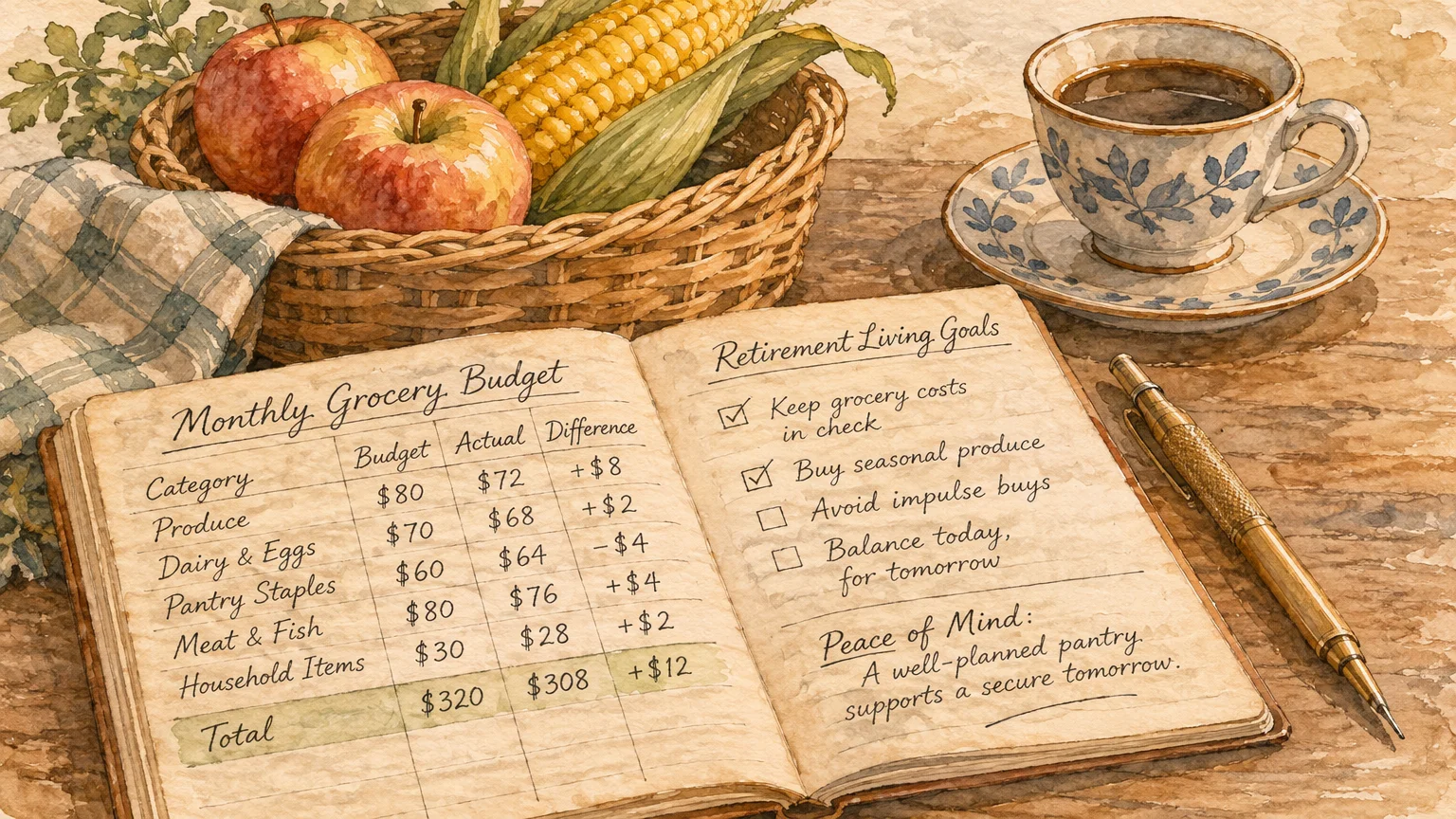
Retirement-Ready Budget That Holds Up
A sturdy retirement budget starts by separating your money into fixed versus variable expenses. A fixed expense stays the same each month—like rent, mortgage payments, or Medicare premiums—while a variable expense changes with your choices, such as groceries, fuel, and electricity.
Write down your guaranteed monthly deposits first, including Social Security and any pension or annuity payouts. Subtract your must-pay fixed bills and set aside a small monthly transfer into a sinking fund for irregular costs like car registration, property taxes, or seasonal heating spikes.
Retirement and benefits information via the Social Security Administration (SSA) and senior living resources via the AARP.
Next, benchmark your grocery target against official USDA Food Plans rather than guessing. Under the September 2026 USDA Low-Cost Food Plan, monthly benchmarks for adults in a four-person household run $268.90 for women ages 51 to 70, $268.20 for women 71 and older, $299.40 for men 51 to 70, and $296.30 for men 71 and older.
Because smaller households cannot split bulk packages as easily, the USDA recommends adding 20% for a one-person household or 10% for a two-person household. That puts a realistic Low-Cost monthly target around $322 to $359 for one older adult, or roughly $590 to $660 for a couple.
Consider a simple monthly walkthrough on $2,400 in net fixed income for a single retiree. Fixed housing, insurance, and phone bills take $1,350, utilities average $210, groceries take $330 using Wednesday markdowns and senior discounts, medical out-of-pocket costs take $140, and $150 goes to sinking funds, leaving $220 for transportation and modest leisure.
If your food budget still feels tight, check whether you qualify for federal nutrition support before dipping into savings. The National Council on Aging (NCOA) notes that more than 9 million eligible older adults are not enrolled in SNAP, even though the average one-person senior benefit provides $188 per month.
Households with someone age 60 or older qualify for SNAP under net income rules and can claim an uncapped excess medical expense deduction for out-of-pocket medical bills above $35 per month. Federal FY 2026 baseline limits through September 2026 were $1,696 gross or $1,305 net monthly income for one person, $2,292 gross or $1,763 net for two people, and $4,500 in countable resources, subject to annual October adjustments.
You can also look into the Senior Farmers’ Market Nutrition Program for fresh produce vouchers and the Commodity Supplemental Food Program, known as the Senior Food Box. NCOA reports that the Senior Food Box provides adults 60 and older at or below 150% of the federal poverty level (130% in some states) with a free monthly box containing up to $50 worth of shelf-stable staples.
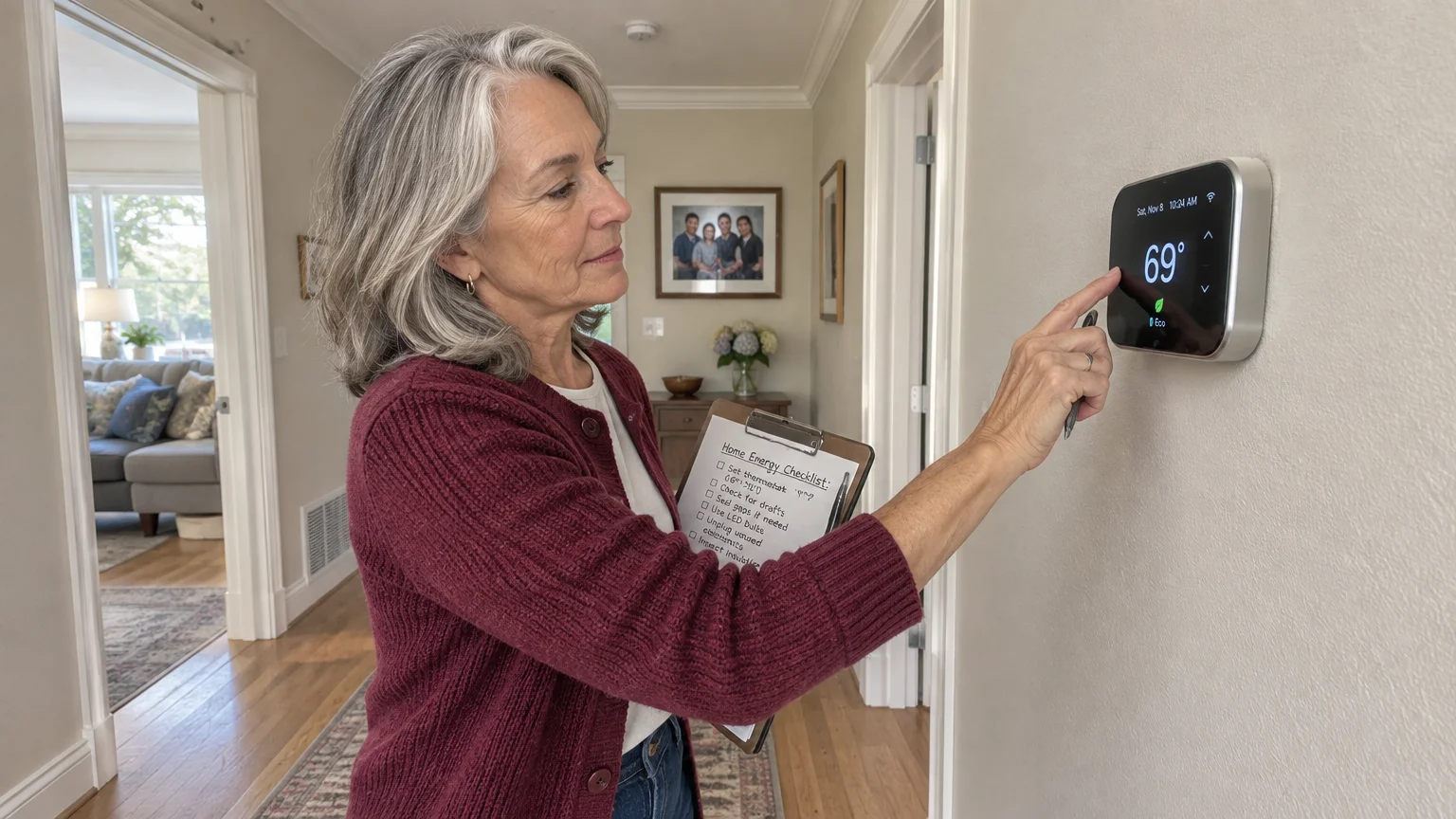
Cutting Utility Bills: A Stepwise Plan
Lowering monthly utility bills protects your cash flow just as effectively as grocery coupons. Start by learning how your electric bill works so you target the biggest drains first.
Electricity is billed by the kWh (kilowatt-hour), which measures using 1,000 watts of power for one full hour. Wattage is the rate at which a device draws power at any moment, and your unit rate is the dollar price your utility charges per kWh or per gallon of water.
Energy efficiency guidance via ENERGY STAR and the U.S. Department of Energy (DOE).
Begin with lighting and standby electronics because they take little effort to fix. Swap remaining incandescent or halogen bulbs in heavily used lamps for LED bulbs, which produce the same brightness using a fraction of the wattage.
Next, plug televisions, cable boxes, microwave clocks, and desktop printers into advanced power strips so you can cut standby power with one switch. Wash laundry in cold water whenever clothes are not heavily soiled, because heating water accounts for most of a washing machine’s energy draw.
Adjusting your thermostat by a few degrees when you sleep or leave for errands delivers steady savings without hurting comfort. Keep heating and cooling vents clear of furniture and swap clogged air filters every one to three months.
For natural gas or electric heating systems, look closely at your ductwork and water heater. Duct sealing means closing gaps and loose joints in air ducts with mastic sealant or metal-backed tape—not cloth duct tape—so warmed or cooled air reaches your rooms instead of leaking into an attic or crawlspace.
Set your water heater thermostat to 120 degrees Fahrenheit to prevent scalding while trimming standby heat loss. Once a year, carefully drain a gallon or two from the bottom tank valve to flush sediment that forces the burner to work harder.
Water bills deserve the same methodical check. Drop a few drops of food coloring into your toilet tank and wait 15 minutes without flushing; if color appears in the bowl, a worn flapper is silently wasting water every hour.
Check the water factor when replacing a dishwasher or clothes washer—a lower water factor means the machine uses fewer gallons per cycle per cubic foot of tub space. In the bathroom, install WaterSense-labeled showerheads and faucet aerators, and trim shower times by two minutes to save both water and water-heating fuel.
Water savings and fixture labeling via the EPA WaterSense. Home product safety via the U.S. Consumer Product Safety Commission (CPSC).
Before buying new thermostats, efficient showerheads, or appliances, search your utility provider’s website for a rebate—a partial refund or bill credit paid after you buy qualifying energy-saving gear. Also ask whether your provider offers budget billing, which averages your annual usage into predictable monthly payments to smooth out winter heating or summer cooling spikes.
Senior Discounts and Quiet Perks
Many retirees leave easy money at the register simply because they never ask about senior perks. AARP notes that participating supermarkets typically offer 5% to 10% off on designated senior days, with age thresholds starting at 55, 60, or 65.
Always carry a government photo ID and sign up for each store’s free loyalty card before checkout. When you reach the register, politely ask the cashier whether the store applies a senior discount automatically or needs a manual code entered before payment.
Do not assume every location of a national chain follows identical rules. Major chains like Kroger, Safeway, and Giant leave senior discount policies to regional divisions—for example, Kroger’s Columbus, Ohio division offers 5% off one day a week for ages 55 and older, while other divisions do not—so verify your local store’s policy at the customer service desk.
Several national retailers reward older shoppers every day of the week rather than locking perks to Tuesday or Wednesday. At roughly 9,000 CVS locations, shoppers 60 and older enrolled in ExtraCare earn 2% back in ExtraBucks Rewards, birthday perks, and senior-specific offers, plus $4 off a first purchase for new members.
Crafters and gift shoppers 55 and older can also claim 10% off their entire purchase—including sale items—every day at Michaels in-store and online with a free Michaels Rewards account. For secondhand clothing, furniture, and kitchenware, check local thrift stores: Goodwill locations typically offer 10% to 30% off one day per week—usually Tuesday or Wednesday—for ages 55 or 62 and older, while Salvation Army Thrift Stores offer 10% to 50% off one day weekly for ages 55 or 60 and older.
General senior associations can pay for themselves quickly when you stack perks intentionally. Joining AARP costs $12 for the first year and unlocks Walgreens Seniors Day eligibility along with perks like 25% off a first DoorDash order of $15 or more, plus travel and dining discounts you can compare against your regular spending.

Beyond Groceries: Services That Can Save You
Food and paper goods are only part of your monthly spending; prescriptions, eyeglasses, hearing aids, tires, and photo prints can strain any fixed budget. Warehouse clubs and large multi-service retailers often discount these big-ticket services well below standalone specialty shops.
Before paying an annual club membership fee, run the numbers without brand loyalty. Compare the annual membership price against the concrete dollars you will save on prescription copays, seasonal tire rotations, battery checks, optical frames, or hearing screenings.
Check whether a warehouse club pharmacy is open to non-members in your state, since many states require pharmacies to serve everyone regardless of membership status. Even if you hold a membership, call two local grocery pharmacies or independent clinics for cash-price quotes before filling an uncovered prescription.
Optical and hearing departments at warehouse clubs frequently run appointment-only schedules, and tire bays often book out days in advance. Call ahead to confirm appointment policies, warranty coverage, and whether your Medicare Advantage plan already covers an annual exam elsewhere for zero copay.
Travel desks and photo centers vary widely by region as well. Treat any membership perk as one quote among three, keeping the business only when the net price after fees beats your neighborhood alternatives.
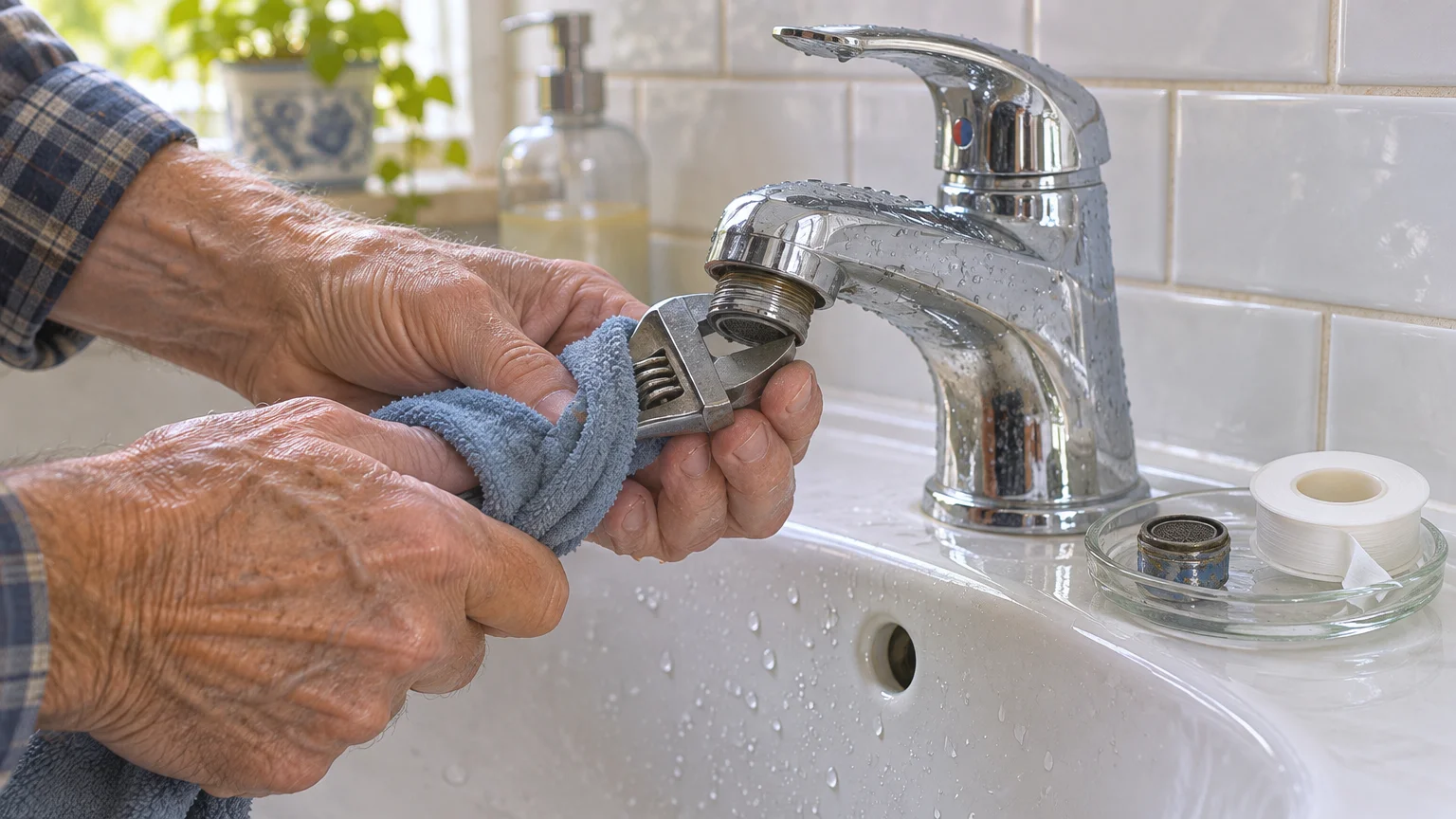
DIY Home Repairs: Safe, Simple Wins
Calling a contractor for minor household annoyances can wipe out a month of grocery savings in one visit. Handling small, low-risk fixes yourself keeps your home safe and preserves your sinking fund for true emergencies.
Fixing a Running Toilet
Lift the tank lid and inspect the rubber flapper, chain, and float valve. If the chain is tangled or the rubber flapper feels slimy or warped, water leaks nonstop into the bowl.
Shut off the wall valve behind the toilet before unclipping the old flapper. A replacement universal flapper costs roughly $5 to $12 at any hardware store and installs by hand without specialized tools.
Wash your hands thoroughly afterward and wipe down spilled tank water so the tile stays slip-free. Call a licensed plumber if the shutoff valve refuses to turn, drips around the base, or if water seeps out onto the floor.
Clearing a Slow Bathroom P-Trap
When a bathroom sink drains sluggishly, hair and soap buildup usually sit inside the curved P-trap pipe directly beneath the basin. Place a plastic bucket and old towel under the pipe before touching anything.
Try a plastic barbed drain snake—usually $3 to $6—from the top drain first before loosening slip nuts by hand or with channel-lock pliers costing $10 to $15. Wear rubber gloves and eye protection so trapped drain cleaner residue never splashes on your skin.
Call a plumber if the pipe joints are corroded metal that resists turning, or if multiple drains back up at the same time. Skip harsh chemical drain openers, which can damage older pipes and release irritating fumes.
Sealing a Drafty Exterior Door
Stand near closed exterior doors on a windy day and feel around the frame for cool air leaks, or look for daylight peeking under the threshold. Worn foam weatherstripping or a cracked door sweep forces your furnace and air conditioner to run overtime.
Peel away crumbling strips, clean the frame with rubbing alcohol, and press self-adhesive foam tape or a screw-on vinyl door sweep into place. Materials run $8 to $20, and you only need heavy scissors, a tape measure, and a screwdriver.
Watch your footing on entry thresholds and use steady lighting so you never trip over tools. Call a handyman or carpenter if the door itself has sagged out of square and scrapes the frame when latching.
Tightening a Loose Cabinet or Door Hinge
Open and close wobbly cabinet doors or squeaky interior doors to spot screws that spin without biting into the wood. Stripped screw holes happen over years of daily use and can eventually crack door trim.
Remove the loose screw, push two wooden toothpicks dipped in basic wood glue into the hole, let the glue dry, and snap the ends flush. Drive the original screw back in using a $6 screwdriver—no power drill needed.
Support heavy interior doors from below with a wooden wedge so the door never drops onto your toes. Call a professional if a heavy exterior fire-rated door is pulling away from a rotted jamb.
Silencing a Squeaky Wood Floor
Walk slowly across squeaky hardwood spots to pinpoint whether two boards are rubbing together or a subfloor board has pulled slightly loose from a joist. Small seasonal gaps often quiet down with simple dry lubrication.
Sprinkle a light pinch of powdered graphite or talcum powder—under $8—into the seam between noisy planks and work it down by stepping gently over a cloth. Wipe up excess powder immediately so the floor never becomes slick under socks or slippers.
Call a qualified contractor if boards feel spongy, sink noticeably underfoot, or show dark moisture stains around bathrooms and exterior walls. Soft spots can signal hidden water damage or joist rot that requires structural inspection.
Worked Examples
Seeing exact numbers turns abstract tips into concrete monthly savings. Walk through these three realistic examples and adjust the inputs to match your own bills.
Example A: Cutting $40 a Month From Your Electric Bill
Suppose your utility unit rate is $0.16 per kWh, and you swap ten frequently used 60-watt incandescent bulbs (running four hours daily) for 9-watt LEDs. That saves 51 watts per bulb—about 2.04 kWh per day across all ten, or roughly 61 kWh per month, cutting $9.76 monthly.
Next, you plug your television, soundbar, streaming box, and home office gear into two smart power strips to cut 60 watts of constant standby draw for 16 idle hours daily. That eliminates roughly 29 kWh per month, saving another $4.64.
Finally, you shift four weekly laundry loads from hot to cold water, trimming roughly 3.5 kWh per load from electric water heating—about 60 kWh monthly, or $9.60—and raise your summer air-conditioning setpoint by 3 degrees for six hours daily to save roughly 100 kWh, or $16.00. Together, those four tweaks cut $40.00 every single month.
Example B: Rebuilding a Budget After a Rent Increase
Imagine Maria, age 72, lives alone on $2,100 in monthly Social Security and sees her apartment rent rise by $125, from $1,050 to $1,175. Previously, she spent $440 per month on groceries—right near the $438 average for older households—and shopped randomly on Saturdays.
Maria shifts her grocery trips to Wednesday mornings for weekly circular specials and Tuesday mornings at Walgreens for toiletries using the 20% first-Tuesday discount. By meal-planning around markdowns and aiming close to the USDA Low-Cost target for a single woman 71 and older ($321.84 with the 20% single-household adjustment), she trims $115 off food without eating poorly.
She also applies the $40 electric reduction plan from Example A, freeing $155 total each month. That covers her $125 rent hike completely and leaves $30 extra for her medical sinking fund—and if her out-of-pocket medical bills exceed $35 monthly, she checks SNAP eligibility using the 60-and-older medical deduction.
Example C: Low-Flow Showerhead Savings and Payback
Suppose your old showerhead flows at 2.5 gallons per minute, and you swap in a $25 WaterSense-labeled model rated at 1.5 gallons per minute. For a single person taking one eight-minute shower daily, water use drops from 20 gallons to 12 gallons per day—saving 240 gallons each month.
At a combined water and sewer unit rate of $0.012 per gallon, water savings equal $2.88 per month. Because you also heat 240 fewer gallons of water each month—roughly 32 kWh of electric water heating at $0.16 per kWh—you save another $5.12 monthly on electricity.
Total savings come to $8.00 per month, meaning your $25 showerhead pays for itself in just over three months—by month four—and keeps saving $96 a year afterward.
FAQs
What are the single best days to shop for groceries if you want both lower crowds and store discounts?
Tuesday and Wednesday mornings offer the strongest mix of calm aisles and direct savings. Tuesday brings senior discount days at chains like Weis Markets, Gristedes, Brookshire’s, and Walgreens, while Wednesday launches fresh weekly supermarket circulars and early-morning meat and bakery markdowns.
Is utility budget billing worth it on a fixed income?
Budget billing helps if extreme winter heating or summer cooling bills strain your monthly Social Security deposit, because it spreads expected annual costs into even monthly payments. Always watch your periodic true-up statement so a mild or harsh season does not surprise you with a lump-sum balance.
Which home repairs require a permit instead of a DIY fix?
Simple swaps like toilet flappers, showerheads, door weatherstripping, and cabinet screws rarely require permits. Projects involving new electrical circuits, main breaker panels, water heater replacements, gas line changes, or structural wall work generally require local building permits and licensed professionals.
How do you verify a senior discount before driving to the store?
Check the store’s weekly ad online or call the local customer service desk directly before leaving home. Regional grocery divisions—such as Kroger, Safeway, and Giant—set rules locally, so confirm the required age, eligible items, and whether a free store loyalty card is mandatory.
What temperature should your water heater be set to for safety and savings?
Setting your water heater to 120 degrees Fahrenheit helps prevent scalding injuries while cutting standby energy waste. Always read your manufacturer’s manual and follow safety precautions when adjusting gas or electric tank controls.
Do plug-in home energy monitors actually help cut electric bills?
Yes, a simple plug-in watt meter shows exactly how much electricity an older garage refrigerator, space heater, or television setup draws over 24 hours. Seeing the real kWh cost makes it easy to decide which appliances to unplug, swap, or retire.
This article provides general informational guidance only and is not financial, legal, medical, or building-code advice. Utility rates, rebates, assistance thresholds, and store senior discounts vary by region and provider, so verify current terms directly with official sources.
Always wear proper safety gear during home upkeep and hire licensed professionals whenever a repair requires permits, specialized tools, or work beyond your comfort level.