Grocery prices keep climbing—U.S. food-at-home costs rose 1.8% year-over-year in September 2026—so stretching every dollar matters more than ever. Smart shoppers rely on repeatable Aldi weekly finds and everyday staples to cut bills without sacrificing nutrition or safety.
Knowing what to grab in the rotating limited-time aisle versus the permanent shelves turns guesswork into a steady routine. You will learn which nine crowd-pleasing items earn repeat cart space and how to verify their real value.
Below, you also get plain-English label checks, safe cold-storage rules, and a worked $50 weekly basket for two. Every tactic uses verifiable unit math rather than aisle hype.
9 Aldi Finds Shoppers Stock Up On Every Week
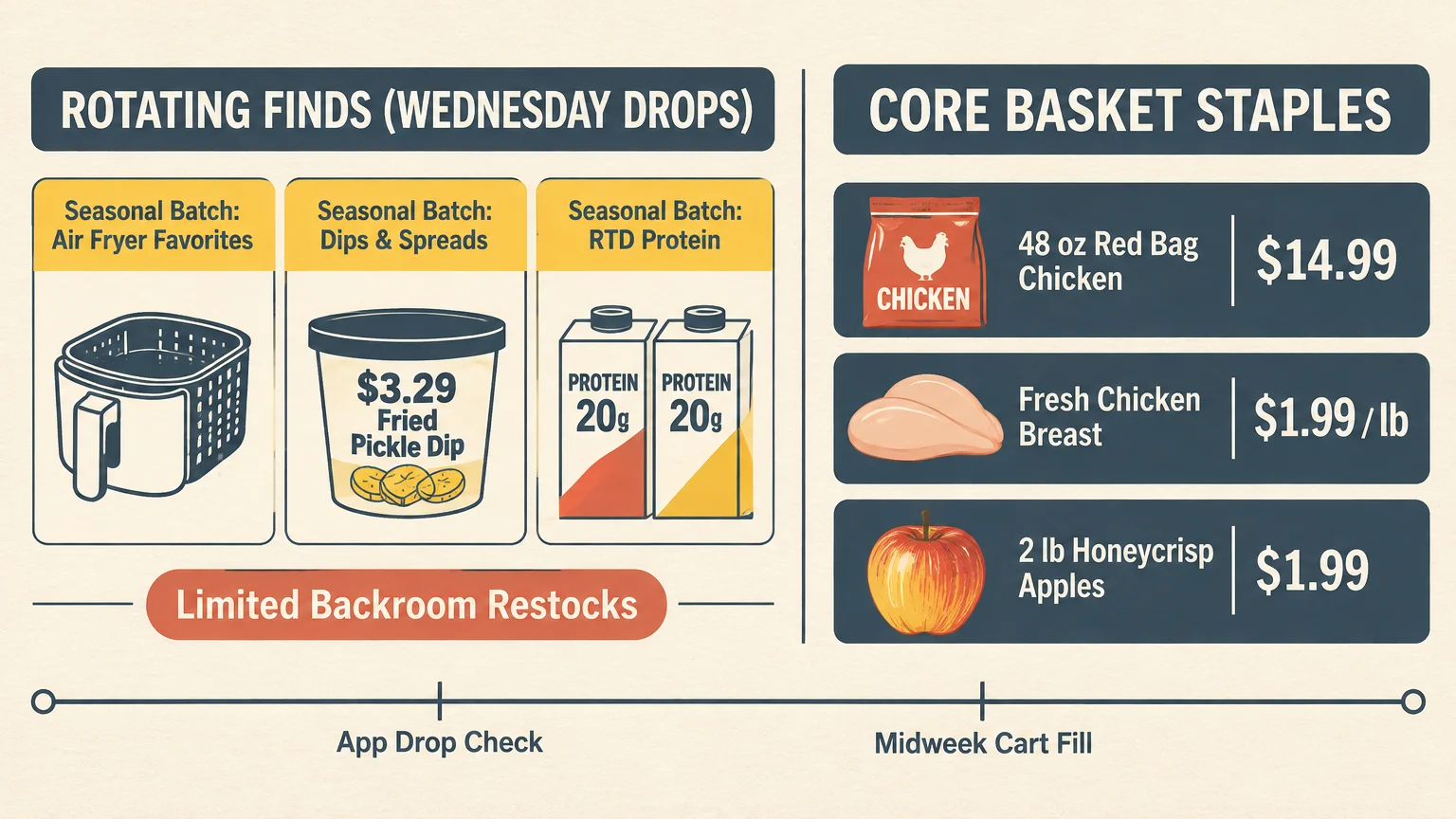
Most U.S. Aldi locations drop rotating, limited-quantity ALDI Finds every Wednesday, while select Sunday Stores refresh those displays on Sundays. You can check your local store’s drop day inside the Aldi app before driving over.
Because stores rarely restock sold-out seasonal batches from the backroom, regulars pair those limited releases with high-value core staples. Private labels make up roughly 90% of Aldi’s assortment and save shoppers up to 22% over competitors’ store brands.
1. Kirkwood Breaded Chicken Fillets (Red Bag Chicken)
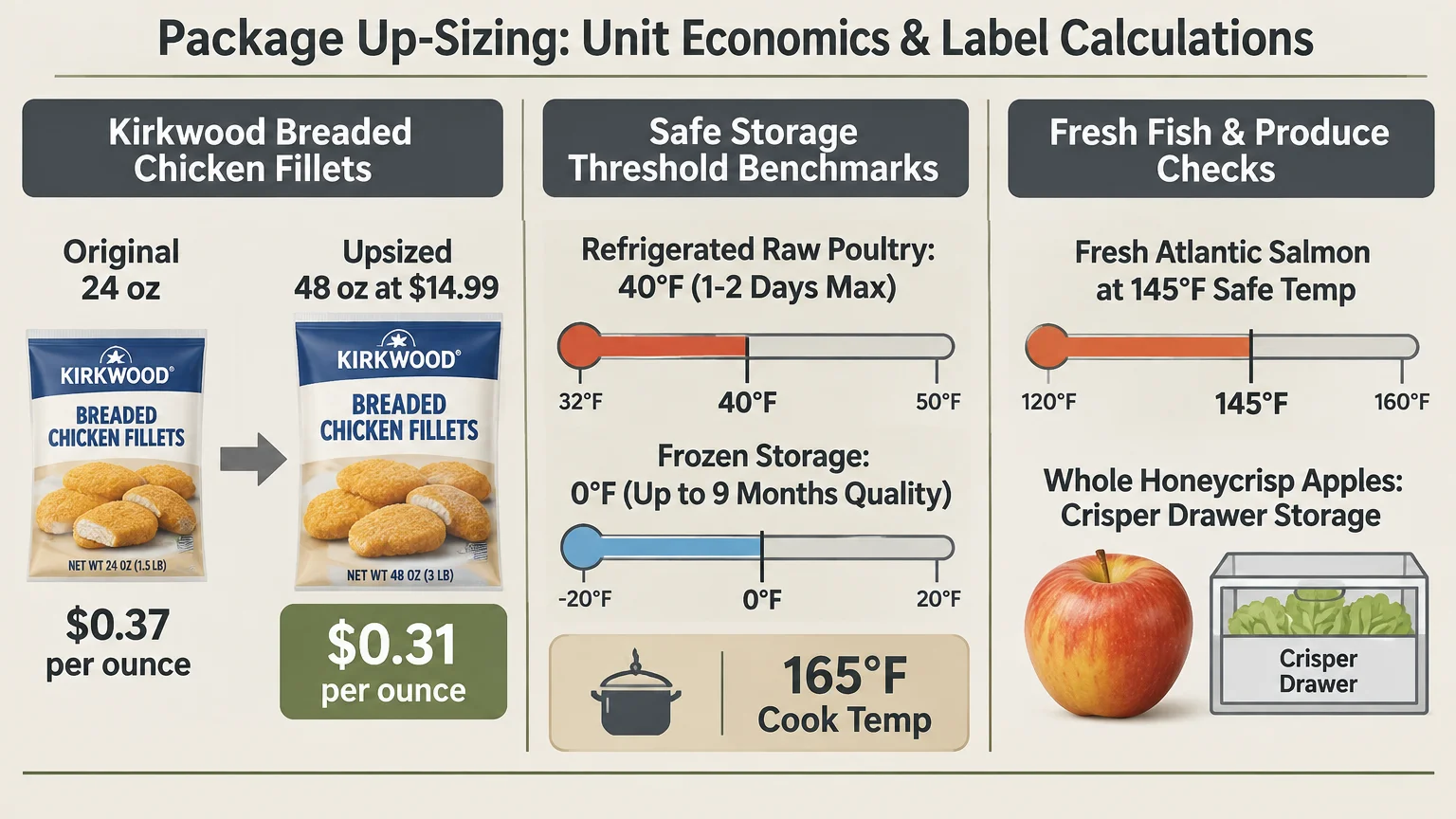
Shoppers nicknamed these frozen fillets Red Bag Chicken for their crisp coating and quick air-fryer convenience. On July 15, 2026, Aldi doubled the package from 24 ounces to a 48-ounce bag for $14.99.
That upsize lowered the cost from about $0.37 to roughly $0.31 per ounce, beating many fast-food sandwich cravings. Keep bags frozen at 0°F or below, and cook every fillet to an internal temperature of 165°F.
2. Kirkwood Fresh Chicken Breast Family Packs
Following Aldi’s $86 million fall price investment on September 23, 2026, fresh chicken breast family packs dropped to $1.99 per pound. That marked the chain’s lowest everyday chicken price since 2022.
Large trays only save money if you freeze what you cannot cook quickly. Raw poultry lasts just one to two days in a 40°F refrigerator, whereas frozen chicken pieces maintain peak quality for up to nine months.
3. Two-Pound Honeycrisp Apple Bags
Aldi priced two-pound Honeycrisp apple bags at $1.99 in September 2026, down 35% from 2025 levels. That puts crisp produce within reach even when household budgets feel squeezed.
Whole apples satisfy sweet cravings with dietary fiber and zero added sugars—sugars added during food processing rather than occurring naturally in fruit. Store bags in your crisper drawer so firmness lasts all week.
4. Fresh Atlantic Salmon
Fresh Atlantic salmon earned a spot in Aldi’s 2024 Fan Favorites survey of 37,000 U.S. voters. Families stock up because portioned fillets cook in fifteen minutes and deliver reliable omega-3 fats.
Check the sell-by date carefully and get fish into your refrigerator within two hours of checkout. Cook fillets until they flake easily and reach a safe internal temperature of 145°F.
5. Park Street Deli Hummus and Specialty Dips
Park Street Deli Hummus also ranked among Aldi’s Fan Favorites, giving budget shoppers an easy plant-protein lunch base. Rotating seasonal tubs—such as Fried Pickle and Ranch Dip at $3.29—turn raw vegetables into quick snacks.
Check sodium per two-tablespoon serving, since savory dips can pack salt faster than plain hummus. Scoop portions into a bowl rather than dipping straight from the tub so opened packages stay fresh longer.
6. Elevation Ready-to-Drink Protein Shakes
Aldi lowered prices on Elevation Ready-to-Drink protein shakes below 2025 levels in September 2026. Morning commuters stock up on multi-packs to replace pricey café breakfasts or drive-thru snacks.
Flip the carton before tossing it in your cart to compare protein grams against added sugars and total calories. Pairing a shake with a banana or handful of oats creates a steadier morning meal.
7. Choceur Chocolate and Freeze-Dried Fruit Snacks
Choceur chocolate bars saw 2026 price cuts alongside core staples, while Simply Nature Chocolate Covered Freeze Dried Fruit won a 2025 Product of the Year award. Both satisfy dessert cravings for a fraction of specialty boutique prices.
Aldi-exclusive foods also avoid certified synthetic colors across the store. Portioning sweet snacks into small weekly containers prevents mindless grazing while keeping grocery spending predictable.
8. Summit Popz Prebiotic Soda and Protein Coffee Drinks
Summit Popz Prebiotic Soda won 2025 Product of the Year honors based on votes from 40,000 shoppers. Meanwhile, weekly finds like the Joyburst Mocha Protein Frappé ($2.45) deliver 10 grams of protein and zero sugar at 50 calories.
Treat functional drinks as optional swaps for higher-cost coffeehouse runs, not daily nutritional necessities. Water and plain brewed coffee still win when you want maximum budget grocery shopping efficiency.
9. Rotating Specially Selected and Mama Cozzi’s Seasonal Releases
Limited-run items like Specially Selected Fall Harvest Mac and Cheese ($2.99), Sourdough Cheese Crisps ($3.85), and themed Mama Cozzi’s pizzas ($5.29) keep weeknight menus interesting. Regulars also watch for Bake Shop seasonal desserts like Pumpkin Sandwich Cookies ($4.99).
Pick one or two seasonal aldi weekly finds that fit an actual meal on your calendar. Skipping unfocused middle-aisle impulse grabs protects both your wallet and your freezer space.
How to Read Prices and Packages
Shelf tags look simple, yet clever packaging tricks can hide real price hikes. Learning three quick price checks stops you from overpaying on autopilot.
Calculating Unit Price Every Time
Unit price means the cost per ounce, pound, liter, or individual count rather than the big bold sticker price. Most grocery shelf tags print unit price in tiny corners, so train your eyes to look there first.
When a store tag omits unit math, divide the total price by total ounces on your phone calculator. A $3.85 bag of sourdough crisps weighing 4.5 ounces costs roughly $0.86 per ounce, letting you compare snacks fairly.
Spotting Shrinkflation Before You Buy
Shrinkflation happens when a manufacturer quietly trims package weight while keeping the retail price identical. Because boxes often keep the same height and width, your pantry runs empty sooner without an obvious price shock.
Suppose a national cereal brand shrinks a 16-ounce box to 14 ounces while holding the sticker at $4.00. Your unit price jumps from $0.25 per ounce to nearly $0.29 per ounce—a 14% hike disguised as steady pricing.
Aldi occasionally moves the opposite direction, as shown by Red Bag Chicken doubling from 24 ounces at roughly $8.79 to 48 ounces for $14.99. Always check net weight in grams or ounces before assuming two packages hold equal value.
Private Label Versus National Brands
Typical U.S. supermarkets keep private labels under 28% of their inventory, pushing shoppers toward higher-margin national brands. Aldi flips that ratio by stocking roughly 90% exclusive store brands.
According to Aldi’s 2025 Price Leadership Report, a family of four saved 36%—over $3,850 per year—choosing Aldi items over national brands at traditional grocers. Individual swaps delivered savings up to 63% without shrinking portion sizes.
Nutrition & Safety, in Plain English
Saving money fails if groceries spoil before dinner or trigger avoidable health surprises. Plain-English label reading and strict cold-chain habits keep affordable food genuinely safe.
Food safety and labeling via the U.S. Food & Drug Administration (FDA) and the U.S. Department of Agriculture (USDA).
Decoding Front-of-Package Claims
Front labels exist to sell products, not to give complete nutrition context. Phrases like natural, artisan, or made with real fruit carry loose marketing weight unless backed by the Nutrition Facts panel.
Watch for ultra-processed foods—industrial formulations built mostly from refined starches, isolated proteins, oils, and flavor additives rather than intact ingredients. Aldi announced plans in April 2026 to eliminate 44 additional ingredients from private-label foods by late 2027.
Even with cleaner ingredient policies, convenience items still vary widely in salt and sugar. Flipping the package takes five seconds and tells the true story.
A Three-Step Label Scan That Takes Ten Seconds
First, check serving size and servings per container so you do not accidentally double your math. A single small bottle or snack bag sometimes counts as two servings.
Second, scan added sugars, sodium, and saturated fat percentages. Daily Value figures under 5% indicate a low source, while 20% or higher signals a heavy hit per serving.
Third, read the ingredient list from front to back because ingredients appear in descending order by weight. If sugar, syrup, or refined flour leads a supposedly hearty item, put it back.
Understanding USP Verification on Supplements
Dietary supplements do not undergo pre-market approval for effectiveness the way prescription drugs do. When buying vitamins or minerals at any grocer, look for USP verification on the bottle.
USP Verified means an independent organization tested the product to confirm it contains the listed ingredients in declared strengths without harmful contaminants. Without third-party seals, shoppers rely solely on manufacturer promises.
Food Safety Rules for Weekly Stock-Ups
The USDA estimates average American households waste 30% to 40% of the food they buy. Safe temperature control protects both your stomach and your grocery budget.
Keep your refrigerator at 40°F or below and your freezer at 0°F or below, checking both with an inexpensive appliance thermometer. Refrigerate perishable meat, fish, and dairy within two hours of leaving the store, or one hour above 90°F.
Respect storage timelines once groceries land in your kitchen. Raw ground meats keep one to two days refrigerated or three to four months frozen, while steaks and roasts keep three to five days refrigerated.
Opened hard cheeses stay good three to four weeks refrigerated, whereas opened soft cheeses spoil within one week. Unopened high-acid canned goods like tomatoes last 12 to 18 months, and low-acid canned meats or vegetables keep two to five years.
Food stored continuously at 0°F remains safe indefinitely, though quality drops over time. Overwrap store-wrapped meat packages in freezer foil or heavy bags if you plan to freeze them longer than two months.
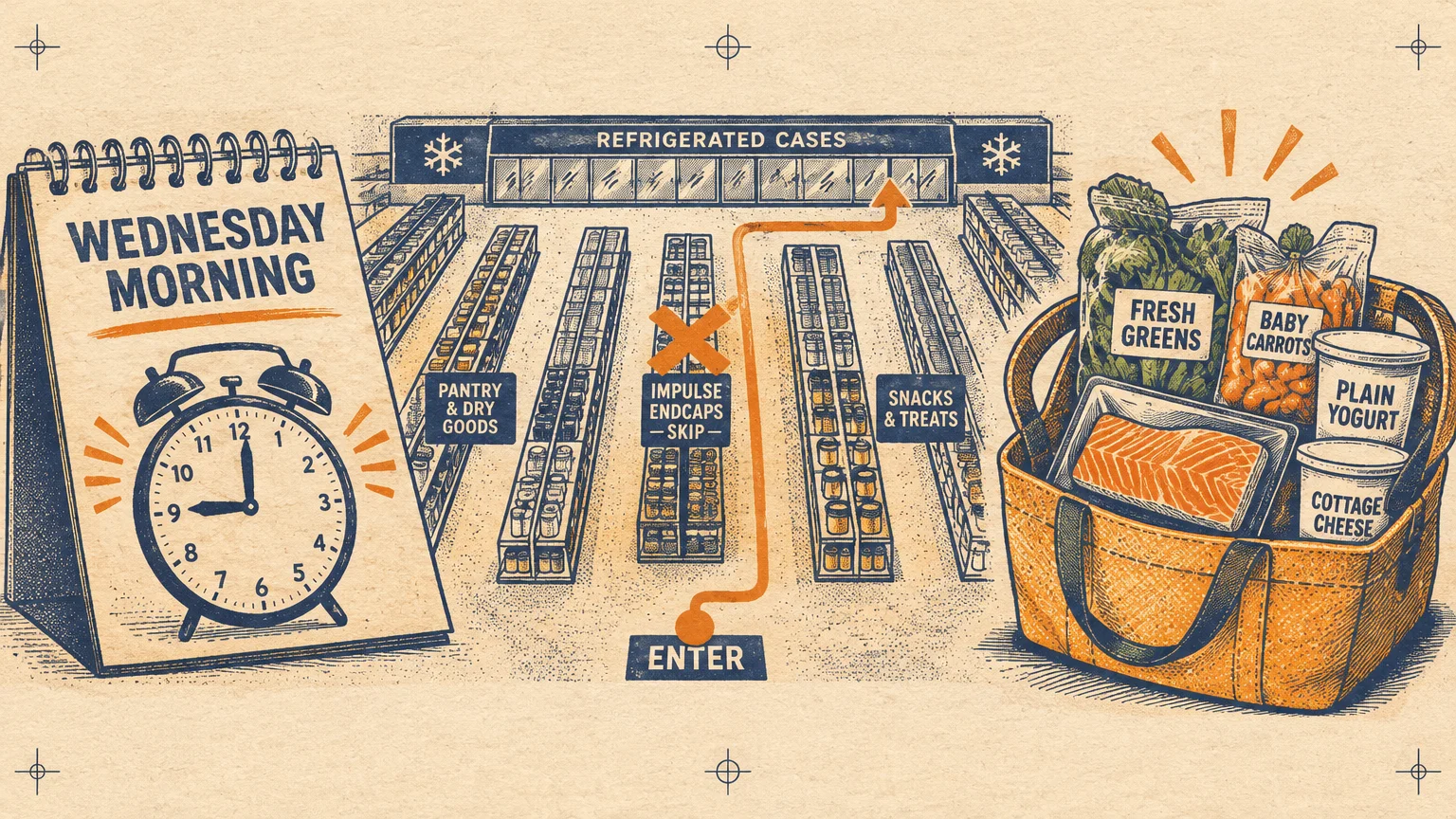
Smart Store Strategy
Consistent savings come from repeatable store habits rather than chasing every flash deal across town. Simple planning trims wasted miles and impulse cart creep.
The Perimeter Versus Center Aisles Myth
Many shoppers hear they should shop only the store perimeter and skip every center aisle. That advice oversimplifies nutrition and punishes tight budgets.
Center aisles hold affordable nutritional workhorses like rolled oats, dried beans, brown rice, canned tomatoes, olive oil, and frozen vegetables. Meanwhile, store perimeters also display high-markup bakery sweets and sugary grab-and-go drinks.
Shop the whole store selectively using a written list instead of rigid aisle rules. Whole ingredients beat ultra-processed shortcuts regardless of which shelf holds them.
Loss Leaders, Rain Checks, and Store Quirks
Traditional grocers advertise loss leaders—items priced near or below cost—to lure shoppers into buying full-priced goods on the same trip. When loss leaders sell out, some regional chains issue rain checks letting you buy later at the sale price.
Aldi skips paper rain checks and complex loyalty tiers in favor of everyday low pricing across its compact layout. Remember to bring a quarter for the refundable cart deposit and reusable bags to avoid checkout bag fees.
Take advantage of Aldi’s Twice as Nice Guarantee if an exclusive food item disappoints you on quality. Bring back the packaging and unused portion for both a full refund and a replacement of equal or lesser value.
Keep in mind that non-food ALDI Finds, alcohol, and national brands are excluded from the double guarantee. Electronics carry a 90-day return window and require your original receipt.
Digital Coupons and Rebate Apps
Because Aldi rarely accepts traditional manufacturer paper coupons, shoppers focus on weekly circular alerts and generic cash-back receipt apps. Scanning receipts for produce or pantry staples you already planned to buy can yield modest rebates.
Never buy an unfamiliar item solely to unlock a digital rebate. Spending $4.00 to earn $0.75 back still drains $3.25 from your weekly food budget.
Pantry Principles and Smart Swap Logic
Build meals around flexible pantry anchors: dry rice, pasta, oats, lentils, canned beans, cooking oil, and basic spices. When your pantry covers base calories, weekly shopping shifts strictly to discounted proteins and seasonal produce.
Use swap logic whenever a planned ingredient jumps in price. If fresh berries double in cost, swap in frozen berries or $1.99 Honeycrisp apple bags for identical fiber at a fraction of the spend.
Worked Examples
Theory sounds nice until Tuesday evening hits and nobody wants to cook. These two realistic walkthroughs show how Aldi shopping tips translate into concrete weekly meals and verified savings.
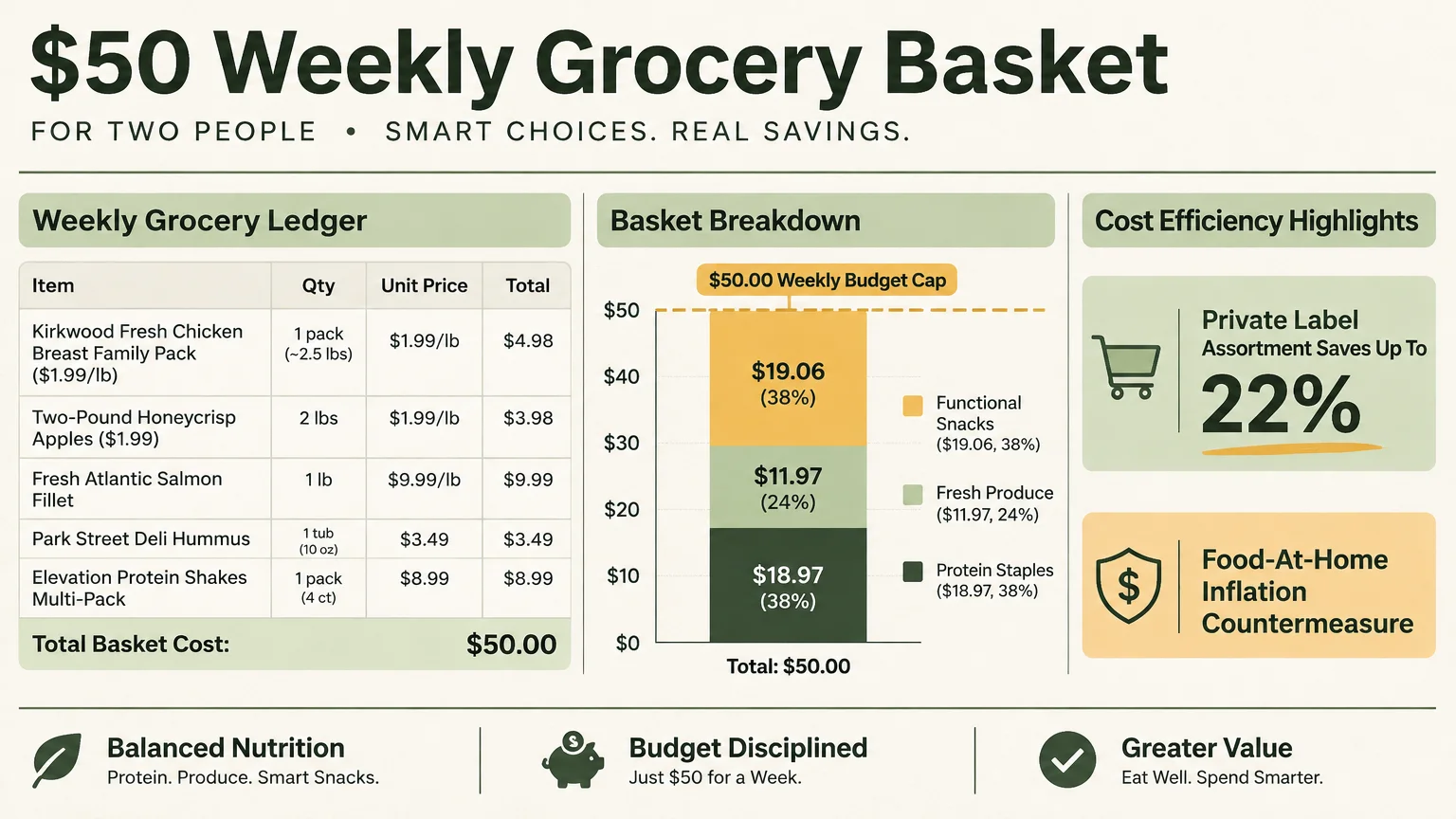
One-Week, $50 Basket for Two
According to the October 2026 USDA Thrifty Food Plan, thrifty weekly food costs average $58.70 for an adult woman and $73.70 for an adult man. Trimming two-person grocery spending toward $50 requires pairing Aldi’s sharpest protein deals with simple pantry staples.
Start your $50 basket with a five-pound family pack of Kirkwood fresh chicken breasts at $1.99 per pound, totaling roughly $10.00. Add a two-pound bag of Honeycrisp apples for $1.99, a $2.99 box of Specially Selected Fall Harvest Mac and Cheese, and a $3.29 Park Street Deli dip.
That leaves roughly $31.73 for core basics: two dozen eggs, rolled oats, a gallon of milk, whole-wheat bread, peanut butter, brown rice, dried black beans, carrots, onions, bananas, canned tomatoes, and frozen broccoli. Keeping non-meat staples simple keeps the full cart near $50 before local tax.
For breakfasts, alternate warm oatmeal topped with diced Honeycrisp apples and scrambled eggs on toast. Lunches combine carrot sticks and tortilla wedges with Park Street Deli dip alongside peanut butter sandwiches or leftover rice bowls.
Dinner one features sheet-pan roasted chicken breasts, carrots, and onions served over brown rice, freezing half the raw chicken immediately for later use. Dinner two turns black beans, canned tomatoes, onions, and spices into fast stovetop chili.
Dinner three pairs baked chicken strips with Specially Selected Mac and Cheese and steamed frozen broccoli. Dinner four uses eggs, leftover rice, onions, and frozen broccoli for quick ten-minute skillet fried rice.
Is It Cheaper to Cook This? Store Brand Versus National Brand
Suppose you crave crispy chicken sandwiches for four people on a Friday night. Driving through a fast-food lane easily pushes four combo-style sandwiches past $25 to $32 before drinks.
At Aldi, using six fillets from a $14.99 48-ounce bag of Red Bag Chicken costs roughly $5.00 to $6.00 for the protein portion. Adding a pack of store-brand brioche buns, sliced pickles, and bagged salad greens brings the entire four-person dinner near $10 to $12 total.
Buying equivalent national-brand frozen chicken fillets and name-brand buns at a conventional supermarket often adds noticeably to the receipt. Cooking the Aldi store-brand version saves $13 to $20 on one meal alone while keeping leftovers neatly portioned in your freezer.
Brand & Retailer Decisions (Neutral)
Brand loyalty should earn its keep every single week. Even dedicated Aldi regulars benefit from knowing when store labels shine and when another retailer or national brand makes sense.
Dietary supplements information via the NIH Office of Dietary Supplements (ODS) and third-party standards at the U.S. Pharmacopeia (USP).
Consumer protection and advertising basics via the FTC. General health guidance via the CDC.
Comparing Store Brands Without Blind Loyalty
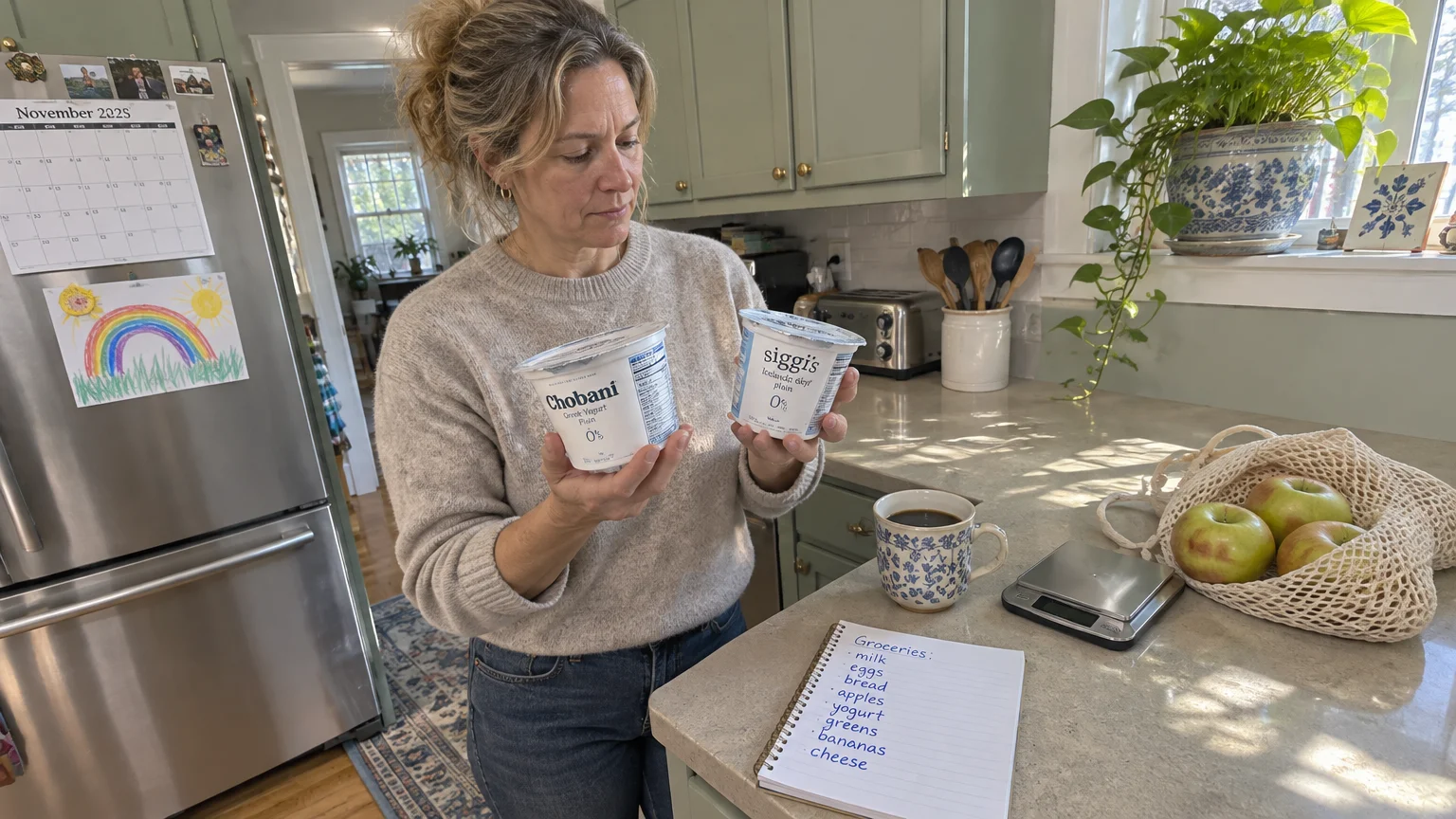
Judge every private-label product by ingredient quality, texture, and unit price rather than store reputation alone. Keep a short phone note tracking family hits and misses so you never repurchase a disappointing box.
Remember that Aldi operates over 2,600 U.S. stores across 40 states and expects to add more than 180 stores in 2026. Even with rapid expansion, smaller footprints mean narrower shelf variety than megastores.
When a National Brand Still Wins
Name brands sometimes justify higher unit prices when severe food allergies require strict single-facility manufacturing transparency. Checking allergen cross-contact statements matters far more than saving fifty cents.
Specialty baking flours, specific infant formulas, and regional condiment favorites also warrant sticking with proven labels. Smart frugal shoppers buy 80% to 90% store staples at Aldi and pick up narrow exceptions elsewhere without guilt.
Supplement Quality and Medication Safety
Over-the-counter vitamins, herbal blends, and protein powders can interact unexpectedly with prescription medications. Always consult a physician or pharmacist before adding new supplements to your routine.
Look beyond flashy front claims and stick to single-ingredient products bearing independent third-party testing seals like USP. Checking interactions first protects your health and prevents wasted money on unnecessary bottles.
FAQs
Are store brands really the same product?
Many private-label foods are manufactured in the same facilities as national brands, though recipes often differ slightly in salt, sugar, or spice ratios. Test one package at a time and keep only the swaps your household genuinely enjoys.
Do coupons still matter?
Traditional clipping matters less at everyday-low-price chains like Aldi because shelf prices already undercut typical promoted rates. Focus first on unit pricing, seasonal produce drops, and avoiding food waste before spending hours hunting coupons.
What does USP mean on vitamins?
USP stands for U.S. Pharmacopeia, an independent nonprofit organization that tests dietary supplements voluntarily submitted by manufacturers. Its verified mark confirms the product matches label potency, dissolves properly, and stays free of unsafe contaminants.
How do I avoid impulse buys in the ALDI Finds aisle?
Set a hard weekly discretionary cap—or check the Wednesday or Sunday preview online—before stepping inside the store. If a gadget or seasonal snack was not on your list, wait 24 hours before buying.
What about buying in bulk for one or two people?
Bulk packs only count as aldi best buys if you actually eat them before spoilage hits. Divide family-size meats into two-portion freezer bags immediately, and skip oversized perishable produce unless you plan to cook and freeze leftovers.
This article is provided for informational purposes only and does not constitute medical, legal, or personalized nutrition advice. Always read current product labels carefully, verify allergen warnings, and consult a qualified healthcare professional regarding dietary supplements, food allergies, or medication interactions. Prices, promotional markdowns, and weekly ALDI Finds availability vary by store location and region.